

In a nutshell
The future of work is already taking shape through the combined efforts of employees, consultants, freelancers, and AI agents. By 2027, companies will be looking above all for talent capable of leveraging AI, bringing together diverse areas of expertise, and generating a measurable impact.
The labor market is becoming much more fluid. Employees, consultants, freelancers, and—in the future—artificial intelligence agents are increasingly working within the same organizations and, at times, on the same projects.
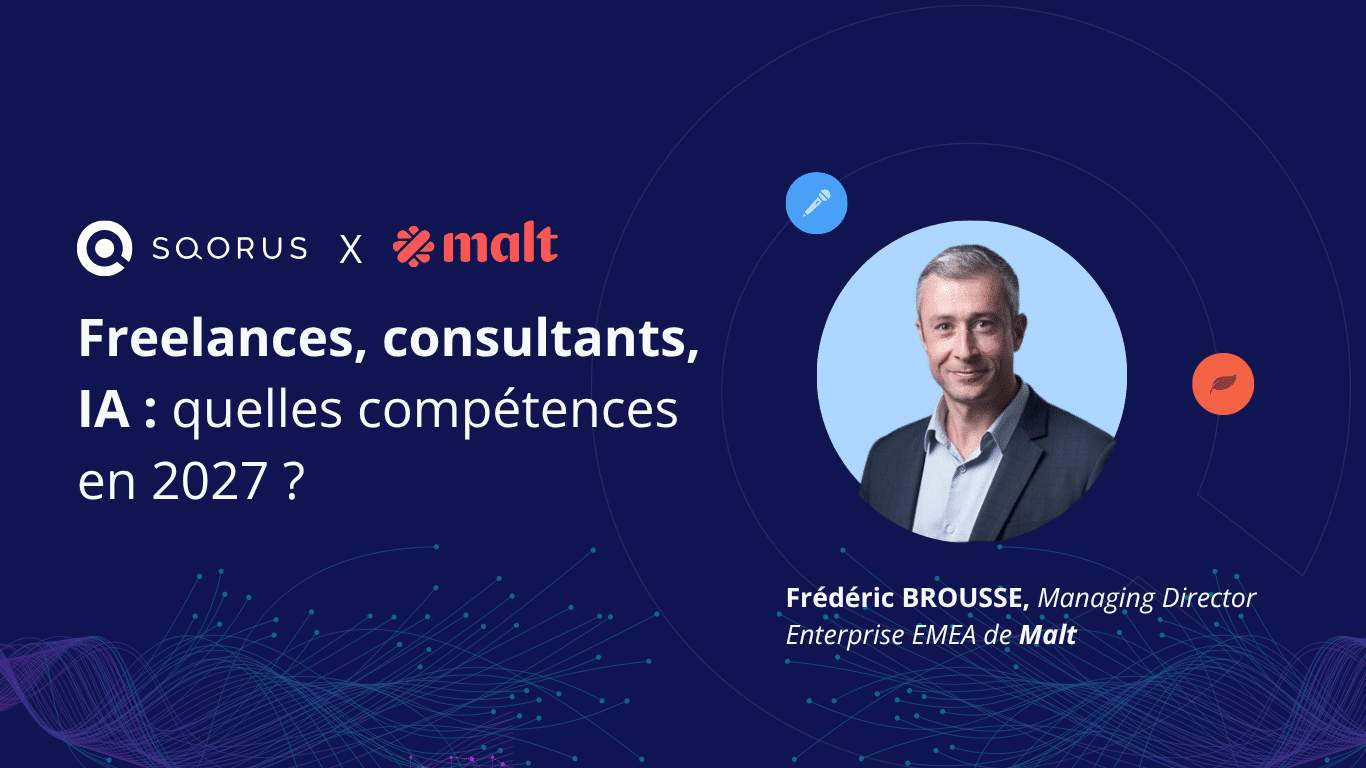
That’s one of the key takeaways from my conversation with Frédéric BROUSSE, Managing Director of Enterprise EMEA at Malt, who joined the platform a few months ago to help drive the growth of its business with enterprises.
His observation aligns directly with what we are seeing at SQORUS in our transformation projects : companies are no longer just looking for additional resources. Above all, they are seeking skills that can be deployed immediately and make a rapid impact within their specific context.
This trend ultimately brings together two worlds that are sometimes pitted against each other: freelance platforms and consulting firms. Despite their different business models, the same question takes center stage: What expertise must we be able to provide to organizations, and how will that expertise evolve by 2027?
1. Freelancing is no longer just a stopgap solution
Founded thirteen years ago, Malt was initially created to address a fairly simple problem: to enable companies—and startups in particular—to easily find the expertise they needed. But large corporations quickly adopted the model.
Today, Malt claims to have more than one million registered freelancers and works with more than 90,000 companies, according to its Malt Tech Trends 2026 study.
The mindset is gradually changing. Freelancers are no longer just people we call on occasionally when we lack a particular skill internally. Some large companies are beginning to truly structure their relationship with this ecosystem, even going so far as to enhance their appeal to freelancers by focusing on the quality of the assignments offered, pay, working conditions, and the option to work remotely for several days.
Frédéric BROUSSE also notes that the profile differs quite a bit from the stereotype of the young worker who has always been self-employed. In Europe, many freelancers already have significant corporate experience before making this choice.
According to Malt’s annual “Freelancing in Europe 2024” study, 94% of the freelancers surveyed had previously held a permanent position.
This topic is particularly interesting for senior professionals. When an expert has ten or fifteen years of experience, working independently allows them to be more selective about the projects they take on while capitalizing on a specialization that has become rare in the market.
For businesses, this also means that a growing portion of the available expertise is no longer necessarily found within their workforce.
2. Firm or freelancer: Value is shifting from the ability to deliver to the ability to provide the right expertise
This is obviously an issue that directly affects us as a consulting firm.
A consulting firm and a platform like Malt do not offer exactly the same service. A consulting firm brings a team, a methodology, the ability to manage a project, and the expertise to contribute to a broader transformation.
Malt, for its part, provides direct access to a vast market of independent professionals, while handling a significant portion of the administrative and compliance issues.
But customer expectations are becoming increasingly similar.
They are looking less for a specific type of service provider and more for the ability to solve a problem. This trend is particularly evident in digital transformation projects. Organizations need business, technological, and organizational expertise all at the same time.
However, the Malt Tech Trends 2026 study reveals a particularly interesting rise in the number of professionals with dual expertise—these “super-connectors” who are able to combine knowledge of a specific field, such as marketing or business strategy, with expertise in automation and emerging technologies.
This is also what we see in our projects at SQORUS. A consultant’s value no longer rests solely on their knowledge of an HR, finance, or IT process, or on their proficiency with a particular tool. It increasingly depends on their ability to bridge the gap between business, technology, data, organization, and transformation.
In other words, expertise remains essential. But expertise on its own is gradually losing its value.
3. By 2027, companies will be looking for candidates capable of coordinating
That’s probably where the change will be most significant.
The data collected by Malt provides a valuable snapshot of emerging skills, as it is based in part on descriptions of thousands of projects and millions of searches conducted on the platform.
Malt also notes that some of these searches serve as “weak signals,” appearing even before the corresponding skills are formally defined in client briefs.
And the current trend is particularly clear: AI is moving from experimentation to implementation.
According to Malt Tech Trends 2026,artificial intelligence has become the second most in-demand skill on the platform. Demand for AI agents is growing at a spectacular rate, and the number of related job postings has increased 60-fold compared to 2024.
Above all, AI is no longer limited to technical experts. It is now considered a mandatory or critical skill in 22% of job postings for non-technical roles, particularly in marketing, design, and management consulting.
Based on these trends, three expectations seem to me likely to become particularly influential in 2027:
Mastering AI in One’s Own Field
It’s not about every consultant becoming a data scientist, but rather about understanding how AI is transforming their field, learning about its use cases, and being able to work with these new tools.
The ability to coordinate multiple areas of expertise
Malt is already seeing a rise in part-time technology leadership roles—such as part-time CTOs or CDOs—who are sought after specifically for their ability to integrate AI, security, data, and governance. In transformation projects, this ability to bridge multiple disciplines will likely become just as important as in-depth expertise in any single one of them.
Focus on Impact and Operationalization
The market is no longer lacking in AI prototypes, demos, or presentations on the technology’s capabilities. Companies now want to integrate these applications into their processes, secure them, govern them, and measure their value. The Malt study thus shows a parallel progression in the areas of governanceand FinOps , and industrialization.
This is undoubtedly where the role of the consulting firm must continue to evolve. Our job is no longer simply to provide consultants with the right skills at a given moment. It also involves anticipating the skills that will become necessary, bringing them together, and helping our clients embed them sustainably within their organizations.
The line between employees, consultants, freelancers, and artificial intelligence technologies will likely continue to blur.
The key question for companies may therefore no longer be, “Who will carry out this task? ” but rather, “What combination of human and technological expertise will enable us to successfully complete this transformation? ”
And this is probably one of the key skills we ourselves will need to develop as firms: knowing how to coordinate this new diversity of intelligences.
Do you have a project? A request? Any questions?
Join a company where it’s a pleasure to work

FAQ
What skills will companies be looking for in 2027?
Three skills should be prioritized: proficiency in AI as it applies to one’s own field,the ability to coordinate various areas of expertise (technical, business, and organizational), and the ability to translate AI applications into concrete, measurable results for the company.
What is a “dual-expertise” or “super-connector” profile?
This is a professional who can combine expertise in a specific field (marketing, finance, HR) with a mastery of emerging technologies, particularlyautomation andAI. These professionals are increasingly in demand because they can directly link a project’s business challenges to its technological challenges.
Will artificial intelligence replace consultants and freelancers?
No. Above all, it is transforming the way we work. While repetitive or standardized tasks are the first to be affected, professionals capable of analyzing a situation, making decisions, and supporting a company remain in high demand—and will be even more so in 2027.