


In brief
Treasury and cash management: two related but distinct concepts.
Cash refers to liquid assets available at a given time.
Cash management encompasses all the strategies and tools needed to optimize, centralize and secure these financial flows.
An essential distinction for any CFO wishing to effectively manage cash flow.
Cash Management vs. Treasury, two similar but not identical concepts
At last, a clear and simple explanation!
When it comes to the financial world of a company, two terms come up very often: Treasury and Cash Management. They are sometimes used as synonyms… yet they have neither the same role, nor the same impact, and do not exactly cover the same reality.
For a Chief FinancialOfficer (CFO), an IS Finance manager or a management controller, understanding this difference is essential for optimizing cash management and securing the company’s financial flows.
This article provides a step-by-step guide to understanding these concepts, their differences, and their role in company management.
What is the Treasury?
Definition of cash flow
Cash represents all available liquid assets actually on the company’s books at a given time.
It consists of :
- bank balances (positive or negative),
- immediately available cash,
- sometimes highly liquid cash equivalents (short-term investments, money-market funds, etc.).
To sum up:
Cash = the money the company actually has in its accounts.
It answers essential questions:
- Can we pay our suppliers?
- Do we have enough cash to pay salaries?
- How much money is available today?
- Are we in surplus or deficit?
- Should we borrow or invest cash?
The role of an operational treasurer
He is responsible for day-to-day cash management. Duties include :
- daily monitoring of bank balances,
- forecasting future cash flows: expected receipts (customers, intra-group, financial, etc.), expected disbursements (suppliers, salaries, taxes, debts), movements linked to financing, changes in bank positions, etc.
- reconciling movements,
- short-term financing,
- day-to-day relations with banks.
Treasury is therefore an operational function focused on the present and the very short term, to ensure day-to-day operations.
What is Cash Management?
Cash management is a broader, more strategic concept.
It is the set of techniques, tools and methods designed to :
- optimize cash flow,
- secure financial flows,
- reduce banking and financial costs,
- centralize and manage group liquidity,
- automate management processes.
Cash Management therefore encompasses :
- cash pooling (including cash sweeping),
- optimizing working capital requirements,
- payment and collection strategies,
- technical tools (EBICS, SWIFT, CAMT/MT reporting),
- risk management (exchange rates, interest rates, liquidity),
- fraud, security and regulatory compliance.
Example: A multinational company with subsidiaries in 15 countries can use cash pooling to centralize its liquidity. Instead of having surplus accounts in some subsidiaries and overdrafts in others, cash management enables these flows to be pooled, reducing banking costs and improving visibility on consolidated cash flows.
In a nutshell: Cash Management is everything you need to optimize, secure and manage your cash flow on a global scale.
This is a more “macro”, systemic approach, often linked to the finance department or even to group strategy.
Treasury vs Cash Management: the differences at a glance
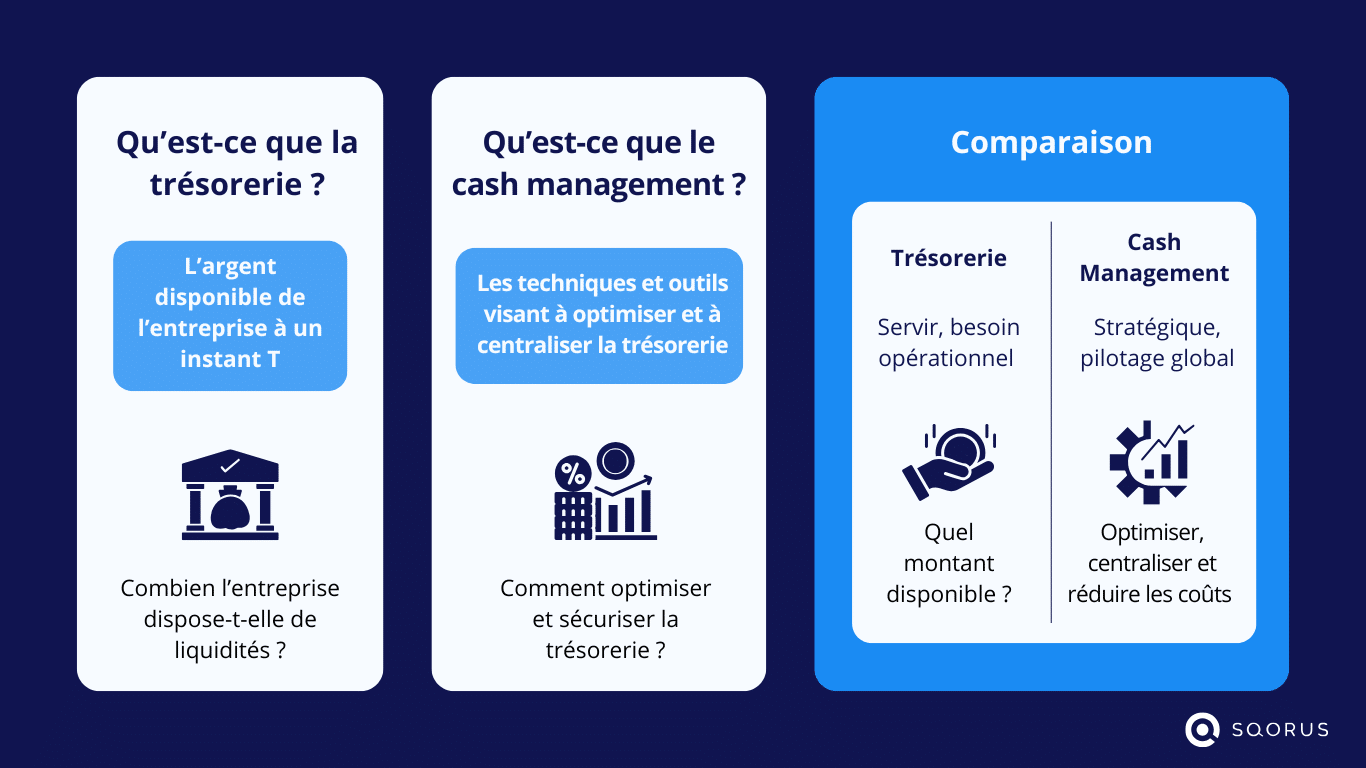
You could say that treasury is a component of cash management, but not the other way around.
A simple analogy to illustrate the difference between treasury and cash management
Cash flow is the level of fuel in the tank.
“Do we have enough to go around today?”
Cash Management is all about managing service stations, routes, costs and vehicle maintenance.
“How to consume less? How to avoid breakdowns? How to plan better? How to reduce costs? “
One is concrete and everyday.
The other is structural and strategic.
Why is it important to distinguish between cash management and treasury?
Because it shows that :
- A company can manage its cash flow well without optimizing it,
- a group can centralize and optimize its cash flows thanks to Cash Management, even if each subsidiary has its own cash position,
- Cash Management brings significant savings, security and better financial governance.
In a nutshell: cash management vs. treasury
- Cash flow = available cash + day-to-day management
- Cash Management = all strategies and tools for optimizing liquidity
- The two concepts are linked, but Cash Management is more global, more technical and more strategic.
At SQORUS, our experts in digital finance transformation support CFOs and finance managers in structuring and optimizing their cash management.
From auditing your current processes to implementing high-performance IS solutions (TMS, forecasting tools, cash pooling), we help you gain visibility, security and efficiency. Contact us!
ISO 20022: 6 steps to avoid rejected payments
On November 18, 2026, unstructured addresses will be definitively rejected by banks. No exceptions. No further delay. Secure your migration with our guide!
Contact
A project? A request?A question?
Contact us today and find out how we can work together to make your company’s digital future a reality.
FAQ
What's the difference between cash flow and liquidity?
Cash flow is cash flow over a given period (day, week, month, year). It can be used to measure changes in cash, either positive (cash generation) or negative (cash consumption).
It can be broken down into 4 sub-concepts:
- Operating cash flow (CFO)
- Investment cash flow (ICF)
- Financing cash flow (CFF)
- Free Cash Flow
In short, cash flow = movement (the flow or filling of the reservoir)
Cash position, on the other hand, corresponds to the amount of money available (or used) in bank accounts at a given moment. It defines the cash position at a given point in time, like a photograph taken.
It is measured by :
- bank balances (all consolidated accounts)
- ± short-term credit lines (drawings/cash balances)
- ± short-term investments
In short, "Cash" = amount (tank level).
Finally, if we were to compare the two :
For the Treasury Manager :
- "Cash is my cash position of the day."
- "Cash flow is the flows that will modify this position."
For the CFO :
- "Cash flow is an indicator of liquidity."
- "Cash flow is an indicator of financial performance."
In general :
- Cash = instantaneous stock of cash (bank position).
- Cash flow = cash flow over a period (change in cash).
Cash flow answers "how much?"
Cash flow answers "how and why?"
What's the difference between WCR and cash flow?
Before we start comparing the two concepts, let's take a quick look at their definitions:
Definition of WCR
WCR (Working Capital Requirement) = operating cycle financing needs
This is the cash needed to finance current operations, i.e. the difference between :
- what the company pays before it is paid (suppliers, inventory, etc.)
- what it collects after delivery (customers)
The formula to remember: WCR = Inventories + Accounts receivable - Accounts payable
WCR is a financial flow, not cash. It measures a structural cash shortfall, but not cash itself.
How to interpret it?
- Positive WCR → company needs to finance its cycle → cash requirement
- Negative WCR → business generates cash (e.g. retail, e-commerce)
Treasury definition
As we saw earlier, cash is equal to available cash at a given moment T.
This is the actual balance of bank accounts (including CT loans, investments, etc.).
It is often calculated as follows Cash = Cash at bank and in hand - Short-term bank overdrafts
It's real cash, managed by the treasurer.
It's an instantaneous position, not a structural need.
The fundamental difference
- WCR measures the need to finance the operating cycle.
- Cash flow measures the amount of cash actually available.
- WCR explains why cash flow varies.
- Cash flow shows how much money the company has.
In layman's terms:
- WCR → lag (structure)
- Cash → cash (instant)
WCR accounts for some of the variations in cash flow. But cash flow also depends on investments, financing, dividends... and overall cash flow.