


In brief
OAC can analyze ERP Cloud data either via a simple but limited direct connection, or via a more flexible and comprehensive classic BI architecture.
The former is fast for standard analyses, the latter ideal for advanced and high-volume needs. The choice depends on the level of customization and complexity required.
In an environment where data is at the heart of decision-making, Oracle ERP Cloud and Oracle Analytics Cloud (OAC) form a duo to transform operational information into strategic insights.
There are a number of different approaches to exploiting and analyzingERP Cloud data in OACdepending on storage, performance and flexibility requirements.
This article explores the main architectures that can be implemented.
What BI architecture is needed to make the most of your data?
There are 2 main approaches to processing and analyzing ERP Cloud data in OAC: one that I would describe as straightforward, and another that is more traditional and generally encountered in Business Intelligence projects.
1. Direct” approach
Simply use the native connection between OAC and ERP Cloud via the Oracle Applications connector.
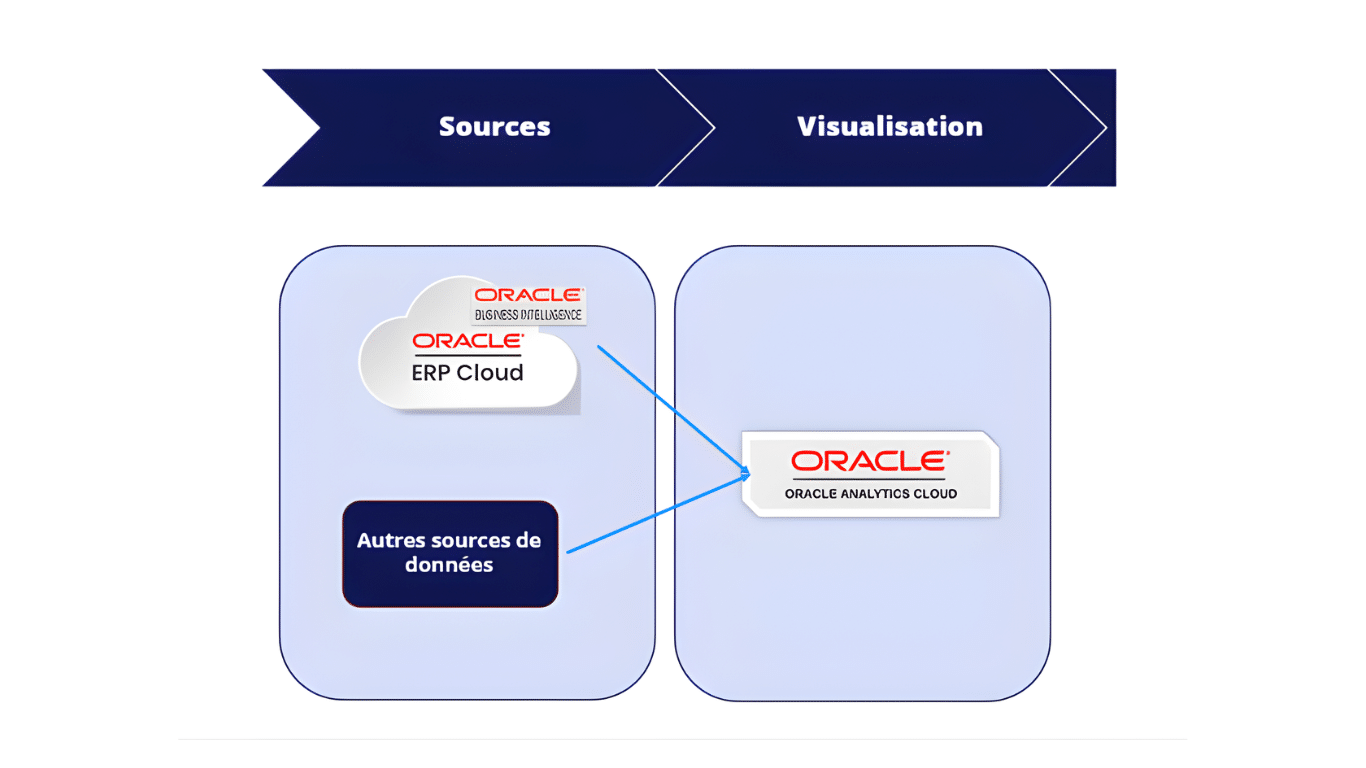
This connector enables data from the Oracle Fusion Cloud Applications suite to be viewed directly in OAC:
- Oracle Fusion Cloud Financials
- Oracle Fusion Cloud Human Capital Management
- Oracle Fusion Cloud Loyalty
- Oracle Fusion Cloud Procurement
- Oracle Fusion Cloud Project
- Oracle Fusion Cloud Supply Chain Planning
- Oracle Sales Automation
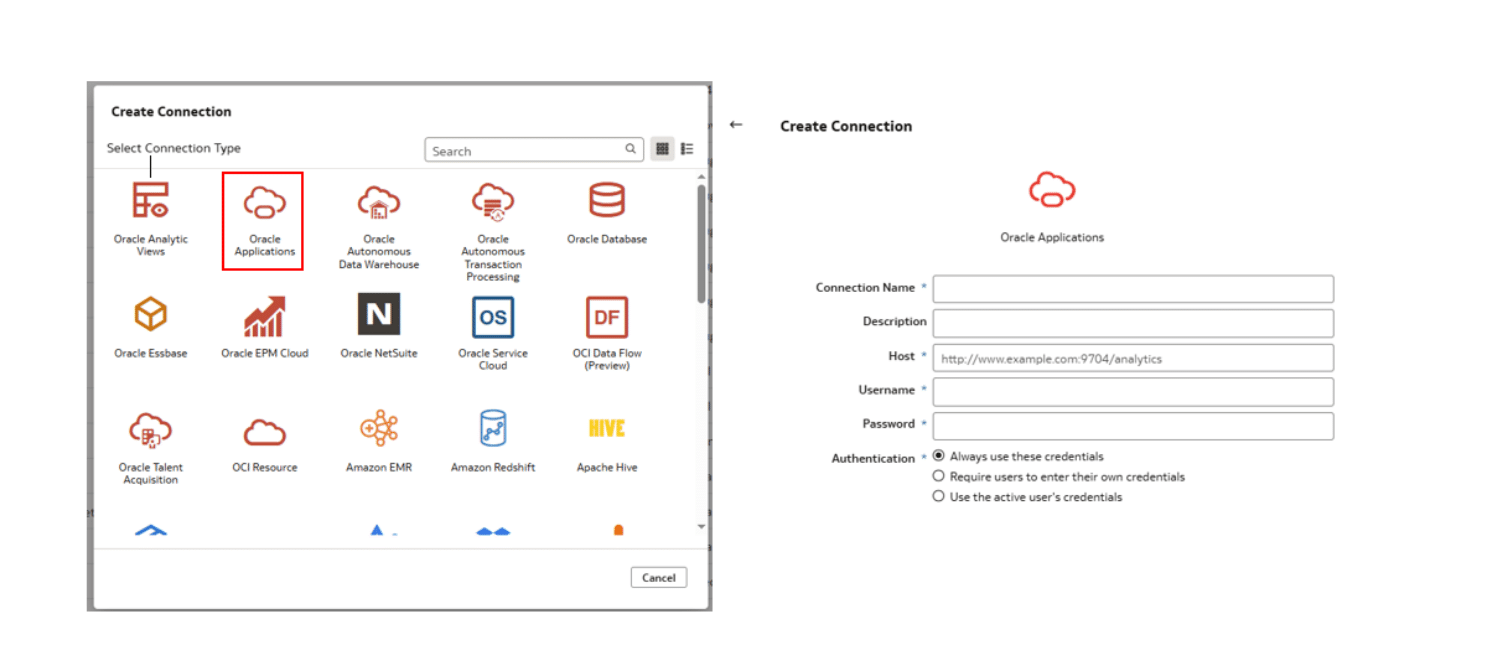
This connection provides access to subject areas and OTBI reports available in Oracle ERP Cloud . Datasets can be created from this data and visualized in Oracle Analytics Cloud.
Benefits
- Simplicity: no need for advanced technical skills. Subject areas are ready to use.
- Speed: native integration with OAC, enabling rapid implementation.
- Security: the connector allows users to log in with their own credentials, limiting access to data according to the rights defined in ERP Cloud.
Limits
- Limited access and reduced flexibility: access only to subject areas and available OTBI reports
- Reduced flexibility: analyses are based on final data from subject area and OTBI reports.
- Uncertain performance: the data available in OAC is that of reports cached in OTBI, over which we have no control
- Limited integration: cross-referencing with other data sources, processing and flows are carried out in OAC, which lacks comprehensive integration tools and offers limited storage capacity (not suitable for processing large volumes).
The direct approach is ideal for rapid, standardized analysis needs, based on existing ERP Cloud reports. It is suitable for business users who do not need to access raw data or perform complex analyses.
2. Classic” approach
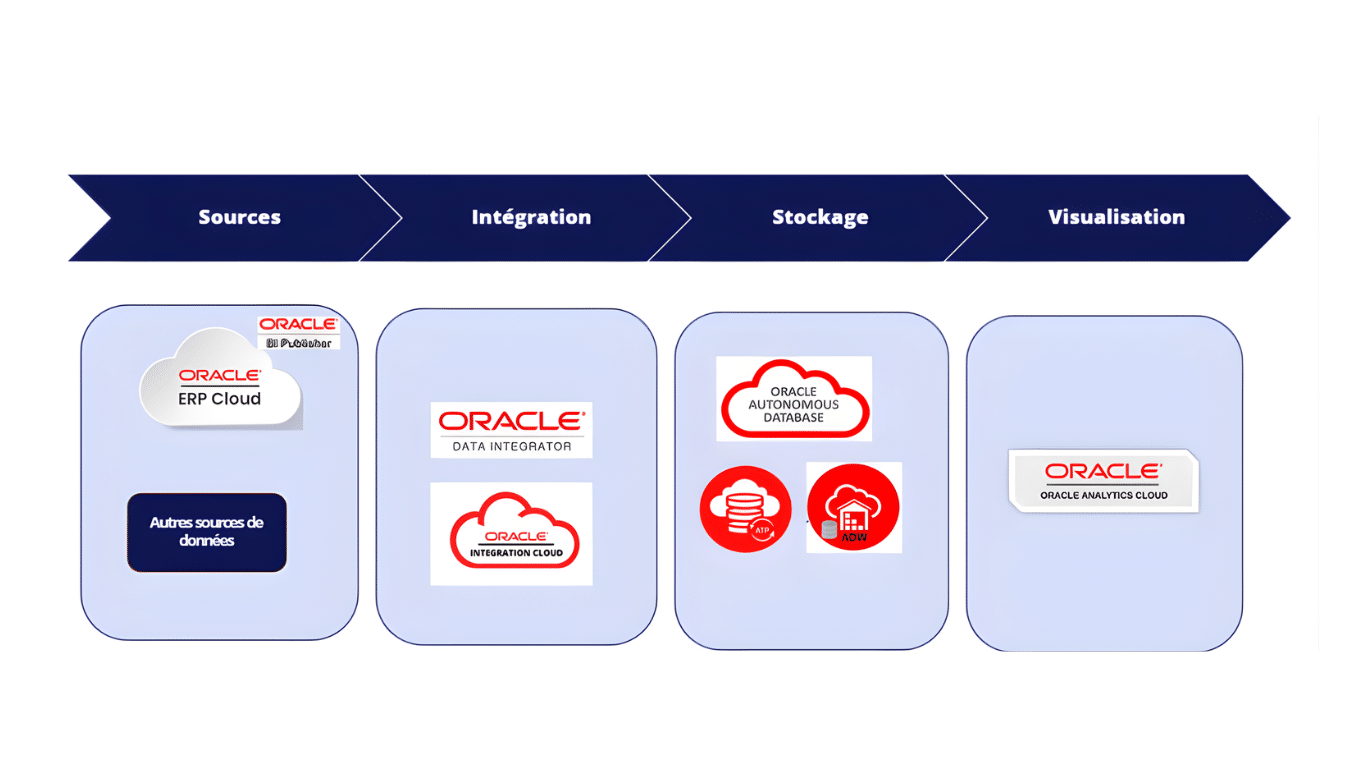
This approach addresses the limitations observed in the first approach, by adopting a classic BI architecture for integrating, processing and storing large quantities of source data for Cloud ERP reports and subject areas.
Benefits
-
Full access: data from all ERP Cloud tables can be analyzed without restriction.
-
Flexibility: you can easily transform and enrich data, and define your own KPIs before analysis.
-
Unlimited volume: data is stored in a datawarehouse optimized for high-volume processing.
-
Multi-source integration: Cloud ERP data can be cross-referenced with other sources (CRM, external data, etc.).
Limits
-
Complexity: implementation requires technical skills (ETL development, configuration, maintenance).
-
Cost: additional licenses for ETL tools (ODI/OIC) and datawarehouse (ATP/ADB)
-
Development time: ETL flow configuration and semantic modeling can be time-consuming, especially for complex analyses.
The classic approach of extracting data from BI Publisher reports is ideal for :
- Access to Cloud ERP source data to calculate and analyze specific KPIs not available in standard subject areas
- Advanced analysis and multi-source cross-referencing.
- Manage large volumes of data.
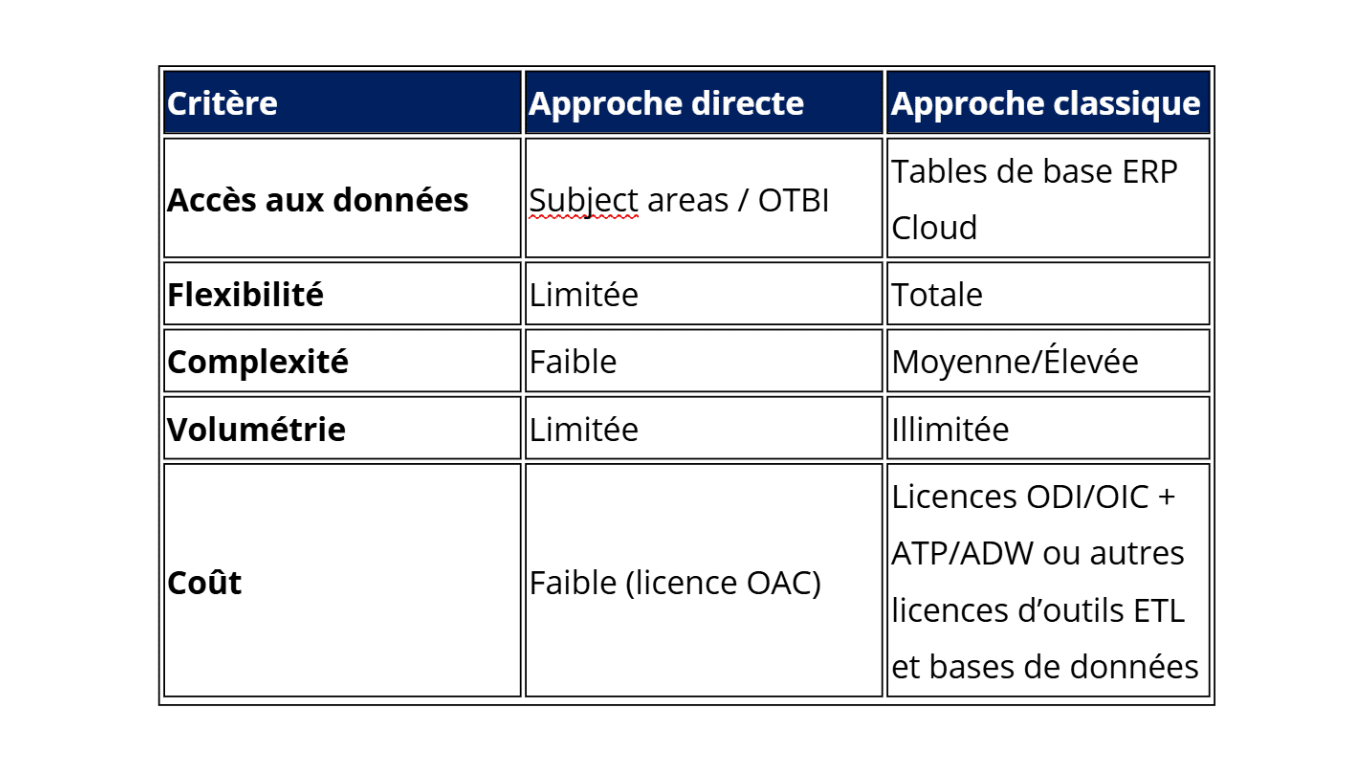
To sum up, here is a summary comparison:
Are you hesitating between the two approaches for your project?
Our SQORUS experts will help you choose the architecture best suited to your needs.

What approach should you choose for your Oracle BI project?
The choice between analyzing Oracle ERP Cloud data from standardized reports or from source data depends on your specific needs.
- Direct approach: ideal for rapid, standardized analyses, without the need for advanced technical skills in Business Intelligence.
- Classic approach: ideal for advanced, customized analyses, with full access to data and maximum flexibility in building your BI architecture.
Whichever approach you choose, a good understanding of business needs and in-depth expertise in Oracle tools (Oracle Analytics Cloud, BI Publisher, ODI, OIC) will be essential to fully exploit the potential of Oracle ERP Cloud data.
SQORUS, Oracle Analytics Cloud and ERP Cloud expert
At SQORUS, a Council firm specializing in the digital transformation of Finance, EPM and HR functions, we’ve been helping our customers implement Oracle Analytics Cloud and Oracle ERP Cloud projects for over 35 years.
Our expertise in Business Intelligence, Oracle Cloud solutions integration (OAC, BI Publisher, ODI, OIC) and Data Management guarantees high-performance, secure BI architectures aligned with your business challenges.
Would you like to turn your Oracle data into strategic leverage and optimize your BI architecture? Our experts are here to help. Let’s talk about it!
Contact
A project? A request?A question?
Contact us today and find out how we can work together to make your company’s digital future a reality.
FAQ
What's the difference between the direct approach and the classic approach to analyzing Oracle ERP Cloud data in OAC?
There are two main architectures for leveraging ERP Cloud data in Oracle Analytics Cloud. The direct approach relies on the native Oracle Applications connector to access subject areas and OTBI reports, without the need for advanced technical skills. The classic approach uses BI Publisher to extract data from ERP Cloud source tables, load it into a datawarehouse via an ETL tool (ODI or OIC) and render it in OAC, offering unlimited flexibility and volume.
What's the difference between OAC and OTBI in Oracle ERP Cloud?
Oracle Transactional Business Intelligence (OTBI) is a native reporting tool integrated with ERP Cloud, enabling real-time analysis of transactional data via predefined subject areas. Oracle Analytics Cloud (OAC) is a more advanced analytics platform, offering visualization, semantic modeling and artificial intelligence capabilities, while integrating with multiple data sources beyond ERP Cloud.
What are the limits of the native OAC / ERP Cloud connector to anticipate before taking the plunge?
The Oracle Applications Connector offers rapid, secure implementation, but has some major limitations: access is limited to the subject areas and OTBI reports available, performance is dependent on the OTBI cache over which you have no control, and storage capacity is insufficient to handle large volumes. These limitations can quickly put the brakes on advanced or multi-source analysis projects.