


In brief
Your on-premise EPM platform is showing its limitations, but a full cloud migration to a single provider isn’t always the right answer.
The Azure + OCI hybrid architecture enables you to modernize your EPM environment without starting from scratch: applications on Azure, Oracle databases on OCI, linked by a secure, high-performance connection.
In this article, find out why this approach is necessary, what a successful hybrid architecture looks like, and the 5 key phases for completing your EPM migration without disrupting your critical processes.
Why consider EPM migration to the cloud in 2026?
Is your on-premise EPM platform nearing the end of its useful life? Migrating to a single cloud is neither realistic nor desirable: your Oracle databases are too critical, your Microsoft ecosystem too integrated?
The Azure + Oracle Cloud Infrastructure hybrid architecture meets precisely this constraint: it preserves your Oracle investments while letting you benefit from the flexibility and services of the Microsoft cloud.
This is the approach that our consultants Smarthys, SQORUS’ EPM Division, deploy with large organizations. Here’s how it works, and how we support it.
Why choose a hybrid Azure + OCI architecture for your EPM migration?
In reality, a “full Cloud” migration to a single provider is not always possible or desirable. Here are a few key reasons why:
- Oracle databases remain critical: solutions such as Essbase or Autonomous Database are designed to run optimally on OCI.
- The Microsoft ecosystem is already well established: Power BI, Azure AD, application servers… so many tools already used on a daily basis.
- The two clouds communicate very well together: thanks to interconnections like FastConnect and ExpressRoute, exchanges between Azure and OCI are fast, secure and reliable.
What does a successful hybrid EPM architecture look like?
Effective EPM migration to the hybrid cloud requires strategic distribution of technical components to maximize the benefits of each platform.
Our experience in EPM migration has enabled us to establish this optimal distribution:
- On Azure: applications (user interfaces, web services, APIs, reporting, Power BI)
- On OCI: Oracle databases (Essbase, ADW, PBCS…)
- Between the two: a secure connection (IPsec VPN or dedicated link) to guarantee smooth, constant exchanges
This architecture makes it possible to maintain high performance, while taking advantage of the flexibility of the cloud and keeping costs under control.
The 5 key phases of a successful EPM migration
This methodology is the result of numerous EPM migration projects carried out by our consultants for major organizations. It is designed to ensure a seamless transition for your critical processes.
At SQORUS, we have defined a clear framework for supporting our customers:
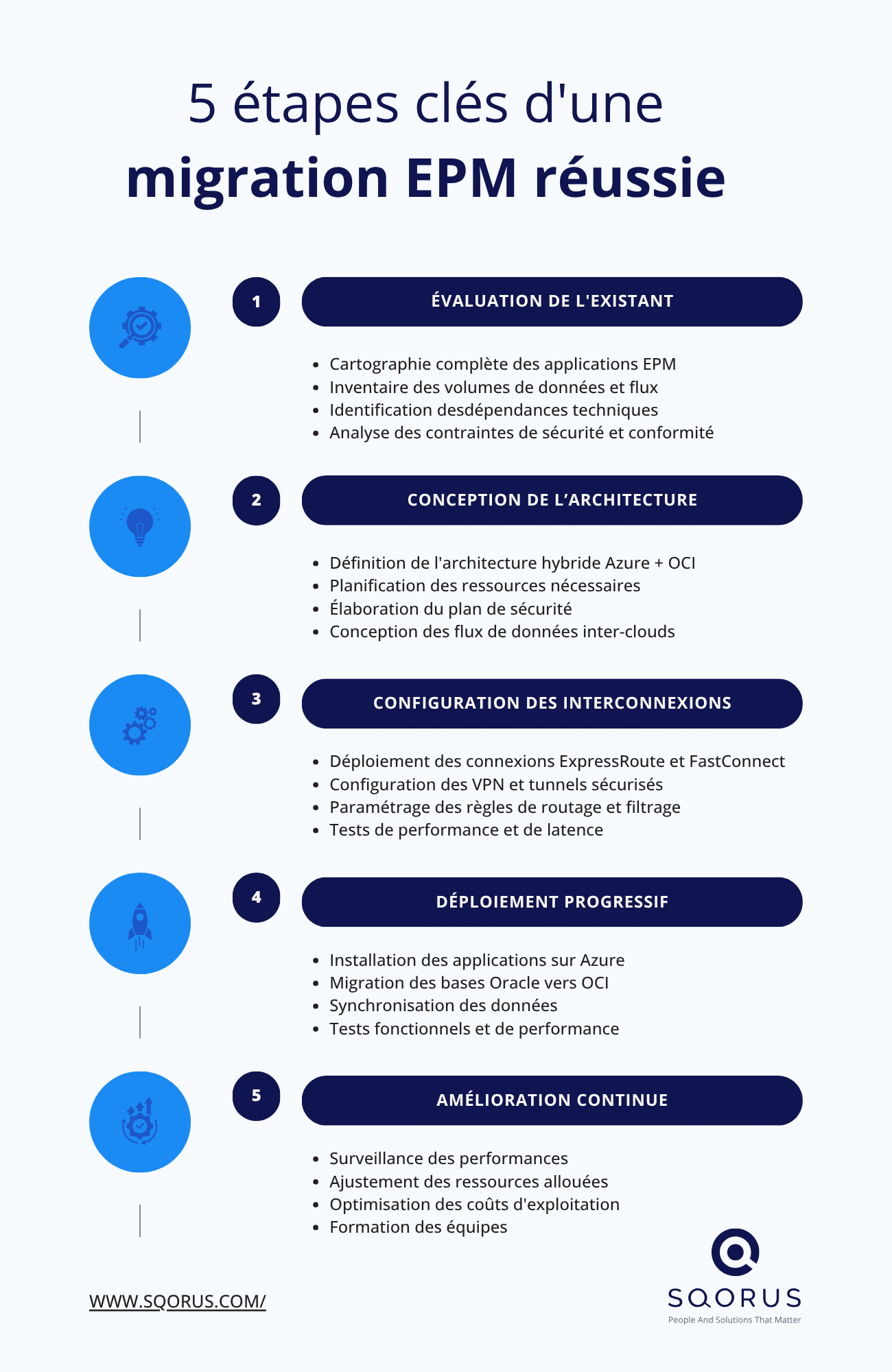
- 1. Preliminary EPM migration analysis: map applications, data volumes, dependencies.
→ Deliverable: Audit report and recommendations
- 2. Design of target architecture for EPM migration: taking into account technical, network and security constraints.
→ Deliverable: Validated architecture blueprint
- 3. Configuration of interconnections: ExpressRoute, FastConnect… with supervision and testing.
→ Deliverable: Validated connection infrastructure
- 4. Progressive rollout of EPM migration: deployment of apps on Azure, migration of databases to OCI, functional testing.
→ Deliverable: Hybrid EPM environment operational. - 5. Optimization and post-migration EPM supervision: monitor flows, adjust configurations, continuously improve.
→ Deliverable: Monitoring dashboard and optimization plan.
Conclusion: Transform your business with strategic EPM migration
EPM migration to a hybrid Azure + OCI architecture is much more than just a technical change, it’s a real transformation lever for your company.
This balanced approach allows you to :
- Preserve your investment in Oracle technologies while benefiting from Cloud innovation
- Accelerate your financial agility with modernized, interconnected EPM tools
- Reduce your operational risks with a gradual, controlled migration
- Optimize your infrastructure costs by adopting a hybrid model tailored to your needs
EPM migration to the cloud is no longer an option, but a necessity if you want to remain competitive in today’s ever-changing business environment. By choosing theAzure + OCI hybrid architecture, you are adopting a future-proof, scalable solution.
At SQORUS, our expertise in EPM migration to the hybrid cloud is based on a methodology that guarantees a smooth transition, without any interruption to your critical processes. Our experts are with you every step of the way, from initial analysis to post-migration optimization.
Ready to begin your EPM migration? Our consultants are available to carry out a personalized diagnosis of your environment and propose a roadmap tailored to your strategic objectives.
All about IT project governance
Discover the roles and responsibilities of key profiles, as well as best practices in governance and technological development, to ensure the success of your digital transformation projects.
Contact
A project? A request?A question?
Contact us today and find out how we can work together to make your company’s digital future a reality.
FAQ – EPM migration to the hybrid cloud
What's the difference between a full cloud EPM migration and a hybrid architecture?
A full cloud migration transfers all components to a single provider. The hybrid Azure + OCI architecture intelligently distributes components according to their needs: applications on Azure, Oracle databases on OCI. This approach is best suited to organizations with critical Oracle investments (Essbase, ADW, PBCS) and a well-established Microsoft ecosystem.
Why combine Azure and OCI rather than migrate everything to a single cloud?
Oracle solutions such as Essbase and Autonomous Database are designed to run optimally on OCI. Forcing their migration to Azure would degrade performance and complicate maintenance.
Conversely, application layers, reporting and tools like Power BI integrate naturally into the Azure ecosystem.
The combination of the two offers the best of both worlds, with FastConnect and ExpressRoute interconnections guaranteeing fast, secure exchanges.
How long does an EPM migration to the hybrid cloud take?
The duration depends on the complexity of the existing environment, the number of applications and data volumes. SQORUS' 5-phase methodology enables migration to be sequenced to limit risks and guarantee continuity of critical processes, from preliminary analysis to post-migration optimization.
What are the risks of an ill-prepared EPM migration?
The main risks are: interruption of closing or reporting processes, loss of data during transfer, latency problems between application layers and databases, and additional costs linked to inadequate cloud sizing.
A rigorous preliminary analysis and mapping of applications, volumes and dependencies enables us to anticipate and neutralize them.