

HR reporting is crucial to human resources management, particularly in cloud environments such as HCM(Human Capital Management). To ensure that HR reporting is effective and relevant, precise methodologies and clear best practices must be followed.
If you’d like to find out more about the tools available for HR reporting, we invite you to read our previous article on Oracle’s major HR Reporting tools, which looks in detail at Oracle BI Publisher, Oracle Transactional Business Intelligence (OTBI) and Fusion Data Intelligence (FDI).
This article explores HR reporting methodologies, processes and steps for creating effective HR reports, best practices for collecting, analyzing and presenting HR data, and the use of predefined templates and formats to standardize HR reports.
HR reporting methods in Oracle HCM Cloud
An HR reporting approach involves establishing a clear, structured framework for the creation and management of HR reports. Here are some key elements of this approach:
- 1. Before starting to create reports, HR reporting objectives need to be clearly defined. This may include objectives such as workforce tracking, performance analysis, talent management, etc.
- 2. Once the objectives have been set, it’s important to find the Key Performance Indicators (KPIs) that can measure success against the objectives. These KPIs can be different, depending on what the company wants to achieve.
- 3. We need to collect and store human resources information. It’s important to check that the information collected is reliable, complete, consistent and in real time. In a Cloud environment like HCM Cloud, data can be collected from a variety of sources, such as HR systems, performance management tools, and employee surveys.
- 4. Data analysis and report generation: Analysis can include techniques such as trend analysis, benchmarking, predictive analysis, etc. The reports created must be clear, concise and easy for everyone to understand. Reports must be clear, concise and easy for everyone to understand.
Processes and steps for creating effective HR reports
The process of creating effective HR reports includes several key steps, such as :
1. Identification of reporting requirements
The first step is to determine the specific HR reporting requirements. This can include the definition of required reports (specifications), report recipients, report generation frequencies (scheduling), etc.
2. Data compilation and organization
Once the reporting requirements have been identified, it’s time to collect the data needed to create the reports. This data can come from a variety of sources.
3. Data analysis
Once the data has been collected, it needs to be analyzed to obtain useful insights.Descriptive, comparative and predictiveanalysis are just some of the techniques that can be used in this analysis. Or simply a list of the information needed to track employees, based on selected filters and then compiled in an Excel file.
4. Report creation
Once the data analysis is complete, HR reports need to be created. These reports need to be concise and clear for stakeholders. They can be presented in the form of graphs, dashboards, Excel exports and Powerpoint documents.
Best practices for collecting, analyzing and presenting HR data
To ensure the quality and relevance of HR reports, it is important to follow certain best practices throughout the process, such as :
1. Use of trusted data sources
It’s crucial to ensure that the data used to create HR reports is reliable, accurate and up-to-date. This may require data validation and verification at regular intervals.
2. Standardization of report formats and templates
Predefined formats and templates can be used to create reports, ensuring that HR reports are consistent and comparable. This can include the use of dashboards, standardized report templates, Word or Excel templates, etc.
3. Data security and protection
Protecting the confidentiality of HR data throughout the reporting process is essential. Measures such as pseudonymizing data, limiting access to sensitive data, accessing information according to its AOR (Ares of Responsibility) can be included.
4. Stakeholder participation
Throughout the HR reporting process, from the definition of reporting requirements to the presentation of final reports, key stakeholders must be involved. This will ensure that reports meet stakeholder needs and expectations.
Use predefined templates and formats to standardize HR reports
To facilitate the creation and management of HR reports, predefined templates and formats can be used. These templates can be customized to the organization’s specific needs, stamped with the company logo, and provide a basis for creating reports. By standardizing employee reports, it’s easier to check that information is consistent and compared across the organization.
The SQORUS methodology: a structured approach to effective HR reporting
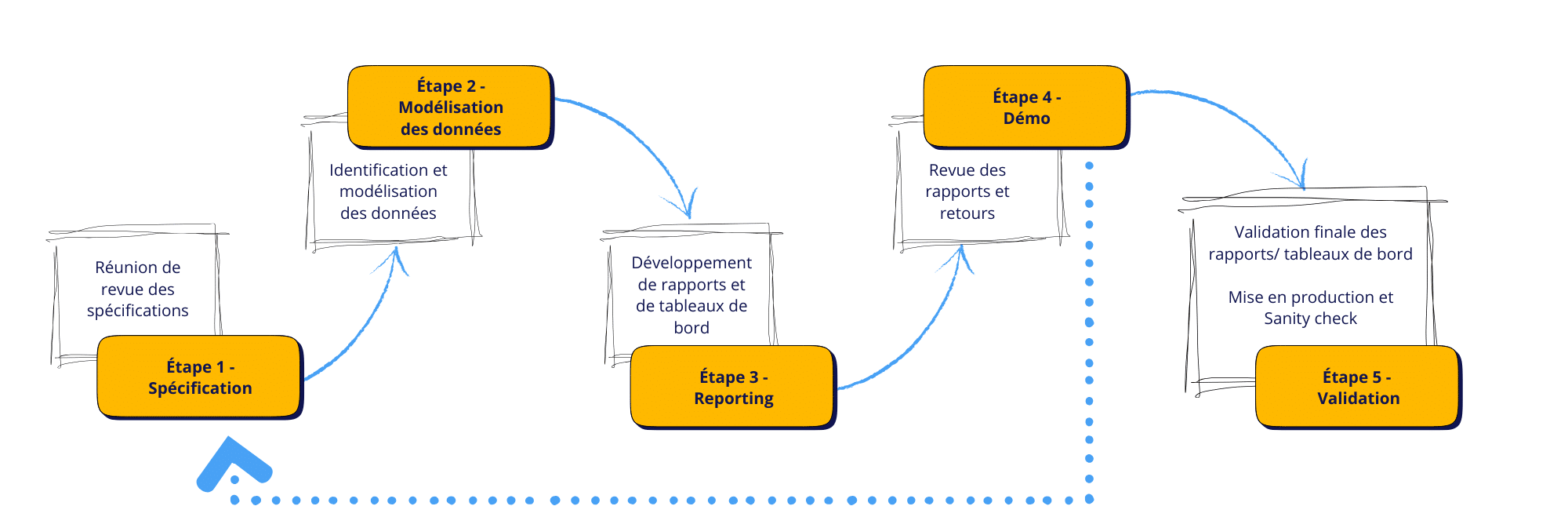
At SQORUS, we have developed a 5-step methodology to ensure the success of your HR reporting projects.
This structured approach ensures the creation of reports and dashboards that precisely meet your business needs, while making full use of the platform’s technical capabilities.
Our methodological approach offers many advantages:
- Optimal quality of reports and dashboards thanks to continuous validation
- Adoption facilitated by user involvement throughout the process
- Time and cost control thanks to a structured framework
- Gradual transfer of skills to your in-house teams
Our team of experts is ready to support you inoptimizing your HR reporting, whether you’re just starting out or looking to upgrade your existing analytical capabilities.
Conclusion – HCM Cloud HR reporting
In a nutshell, HCM Cloud’s HR reporting methodology and best practices are key to creating effective and relevant HR reports. Organizations can make informed strategic decisions by getting the most out of their HR data by following a precise methodology, adhering to best practices and using the right tools and templates.
To take your mastery of HR reporting a step further, we invite you to discover our next article dedicated to advanced HR Reporting skills and functionalities with Fusion Data Intelligence (see you on June 19, 2025). You’ll find detailed information on the analytical capabilities of this solution, and the skills you’ll need to exploit its full potential in your organization.
HR Data strategy: what if we accelerated?
Imagine a world where the HR function is propelled into a new dimension thanks to the power of data. What if this world were within our reach? Discover how to harness the full potential of HR Data to revolutionize your organization.
Contact
A project? A request?A question?
Contact us today and find out how we can work together to make your company’s digital future a reality.