


In brief
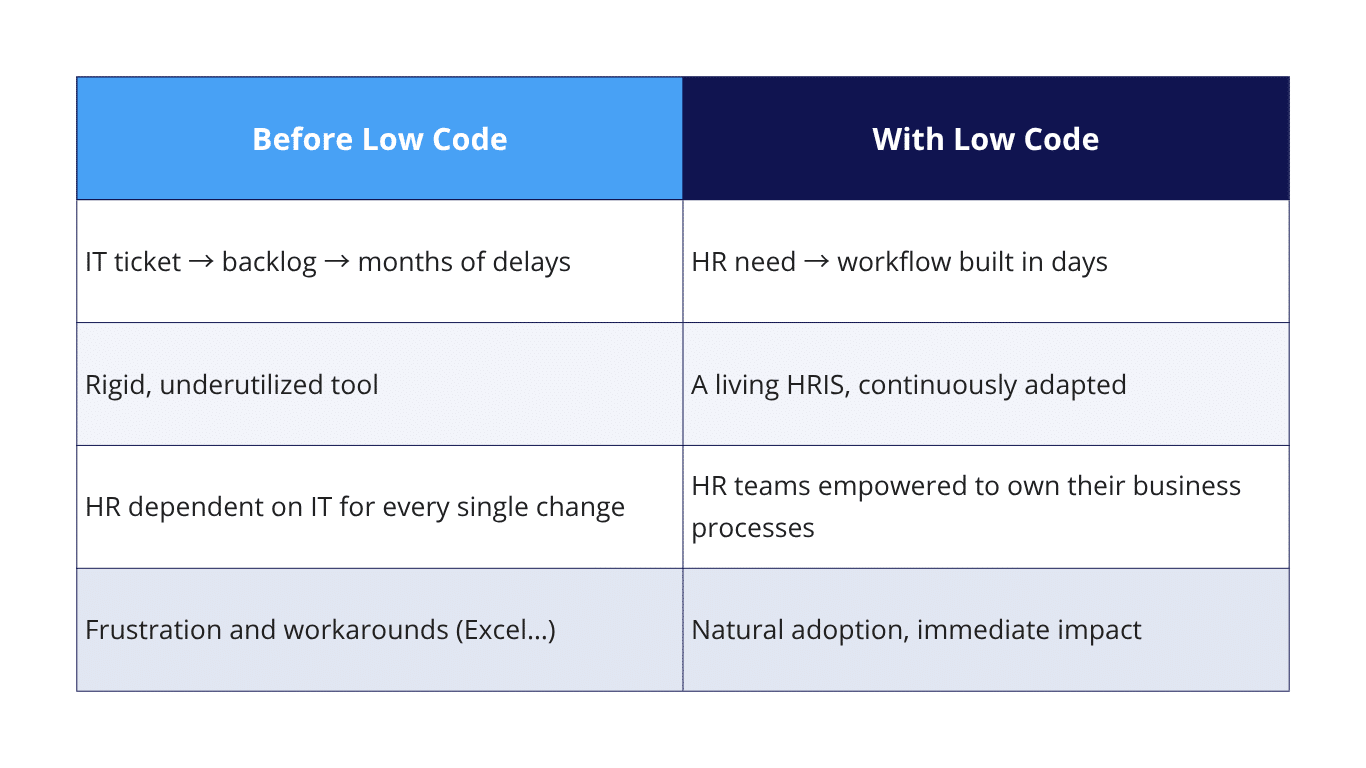
Blocked IT tickets, under-utilized HRIS, manual processes… Low Code enables HR teams to regain control of their tools, without waiting for IT and without writing a line of code. Here’s an overview of concrete use cases and the SQORUS approach.
“We submitted the ticket to IT in January. Now it’s April. Still waiting. “
We hear this phrase in almost every organization we work with.
An HR manager wants to modify an onboarding form. Add a field to an interview workflow. Create an automatic alert for the end of probation periods.
Simple needs. Urgent. Stuck.
Not because IT is unwilling. But because technical teams are saturated, priorities are arbitrated, and deadlines are incompressible.
As a result, HR teams get around it. They use Excel. They manually rerun what should be automatic. And the HRIS, which is supposed to simplify their day-to-day work, remains frozen, under-used and frustrating.
This is exactly the problem that Low Code applied to HRIS is solving. In concrete terms. And faster than you might think.
What the Low Code means for HRIS in concrete terms
Let’s start by clearing up a misunderstanding. Low Code is not a way of doing without IT. Nor is it a “do-it-yourself” tool reserved for small structures.
It’s a new way of distributing building capacity within the organization.
Why HRIS is the ideal solution
Not all contexts lend themselves equally well to Low Code. But HRIS is almost cut out for it, because HR needs have three key characteristics.
1. Frequent and repetitive needs
Onboarding, offboarding, annual appraisals, absence management, training requests… These processes are repeated hundreds of times a year. Each improvement has an immediate and massive impact.
2. Constantly evolving processes
A new regulatory requirement, a change in collective bargaining agreement, a revised HR policy… The HRIS of 2026 must be designed as a continuous flow, capable of constant adaptation. Waiting six months for IT to make each adaptation is no longer tenable.
3. End-users who know best
HR teams know exactly what they need in an interview form. Better than any developer who doesn’t know the business. Low Code finally gives them the tools to build it themselves.
What HR teams can concretely build
Here are some real-life examples of what our customers are building today, without writing a single line of code.
Onboarding workflow automation
Automatic creation of the employee file, sending of documents for signature, notifications to managers, IT access triggered as soon as HR validation is received. A process that used to take 2-3 days, reduced to a few hours.
Customized dynamic forms
Annual appraisal forms that can be adapted to suit the employee’s profile, department and hierarchical level.
Smart alerts and notifications
End of trial period on D-15, deadline for mandatory training, contract renewal… Automatic triggers to avoid costly oversights.
Customized HR dashboards
Analytical views built by HR teams themselves, on the indicators that matter to them.
Connections between systems
HRIS, collaborative tools, training platforms, ERP… without heavy integration projects.
Your HRIS can evolve today
If you would like to identify the first levers for action in your organization, our experts are available to discuss this with you.

Low Code doesn’t replace IT, it liberates it
This is the most important point, and the one most often misunderstood.
Low Code doesn’t mean that HR teams do IT development. It means that both can finally work on what they do best.
HR teams focus on process adaptations, form adjustments and business workflows.
IT teams focus on architecture, security, complex integrations and data governance.
“It’s a rebalancing. Not a revolution.”
3 questions to ask yourself before taking the plunge
1. What are your most painful processes?
Identify the 2 or 3 HR processes that generate the most friction: delays, errors, manual reminders. This is where Low Code will have the most visible impact.
2. Is your current HRIS compatible?
Check that your solution has the necessary APIs and a compatible Low Code ecosystem (Oracle VBCS, SAP BTP, Workday Extend…) before investing.
3. Are you organizationally ready?
Some profiles within HR teams need to be trained and empowered to build and evolve tools. This is not a developer’s skill, but it is a new skill that needs to be recognized and valued.
Low Code, the key to an HRIS that finally works for HR
An HRIS that waits for an IT ticket to evolve is an HRIS that holds the organization back.
HR teams accumulate workarounds, processes remain frozen, and the value of the system is never fully exploited. This doesn’t have to be the case. Low Code reverses this logic: business needs drive, and tools follow.
Workflows adapt in days rather than months. HR teams gain autonomy without bypassing IT. And HRIS becomes what it should always have been: an operational lever, not an administrative constraint.
This transformation doesn’t happen overnight. It requires identifying the right processes, choosing the right tools, training the right people and establishing the right rules of governance. This is precisely where SQORUS comes in.
For over 35 years, we have been helping large organizations with their digital HR transformation. Our consultants are familiar with all the HRIS ecosystems on the market: Oracle HCM, SAP SuccessFactors, Workday, and master the associated native Low Code environments.
Our role: to help you quickly identify the first gains, structure a sustainable approach, and empower your teams to act on their own.
If you would like to identify the first levers for action in your organization, our experts are available to discuss this with you without obligation.
Read more
Key points to remember
- 75% of HR departments still operate with partially manual or Excel-based processes
- According to Gartner, 70% of new enterprise applications will be low-code/no-code by 2026
- Low Code doesn’t replace IT: it frees up both parties
- First use cases to target: onboarding, alerts, forms, dashboards
- The real challenge: regaining control of your HRIS rather than being subjected to it
- A well-managed HRIS is better than a state-of-the-art, poorly managed one.
Contact
A project? A request?A question?
Contact us today and find out how we can work together to make your company’s digital future a reality.
FAQ – Low code and HRIS
What's the difference between low code and no code?
Low code enables business teams to build workflows and applications with very little code, based on visual interfaces. No code goes a step further: no lines of code are required.
In an HRIS context, low code is generally better suited to large companies that need to connect complex systems (Oracle HCM, SAP SuccessFactors, Workday), while no code is more suited to simpler processes or less complex structures.
Which low code tools are compatible with the main HRIS systems on the market?
The major HRIS platforms have their own native low-code environments: Oracle Visual Builder Cloud Service (VBCS) for Oracle HCM, SAP Build for SAP SuccessFactors, Workday Extend for Workday. Third-party tools such as Microsoft Power Platform can also interface via API.
Does low code in HRIS require technical skills?
No, that's precisely one of its strengths. HR teams can, after a short training course, build and evolve their own workflows without depending on IT for every modification. Governance remains with the technical teams for architecture and security aspects.