

“Is my CV read by an AI?” This is one of the most recurrent questions today when it comes to recruitment. And it’s not a question that comes up by chance.
According to the latest Hellowork survey (2025), 78% of recruiters are now using generative AI in their practices. As for candidates, one in two is also using it in their job search.
To understand the role of AI at SQORUS, the easiest way is to follow the progress of an application, from the creation of the offer to the final decision.
Drawing up a job offer
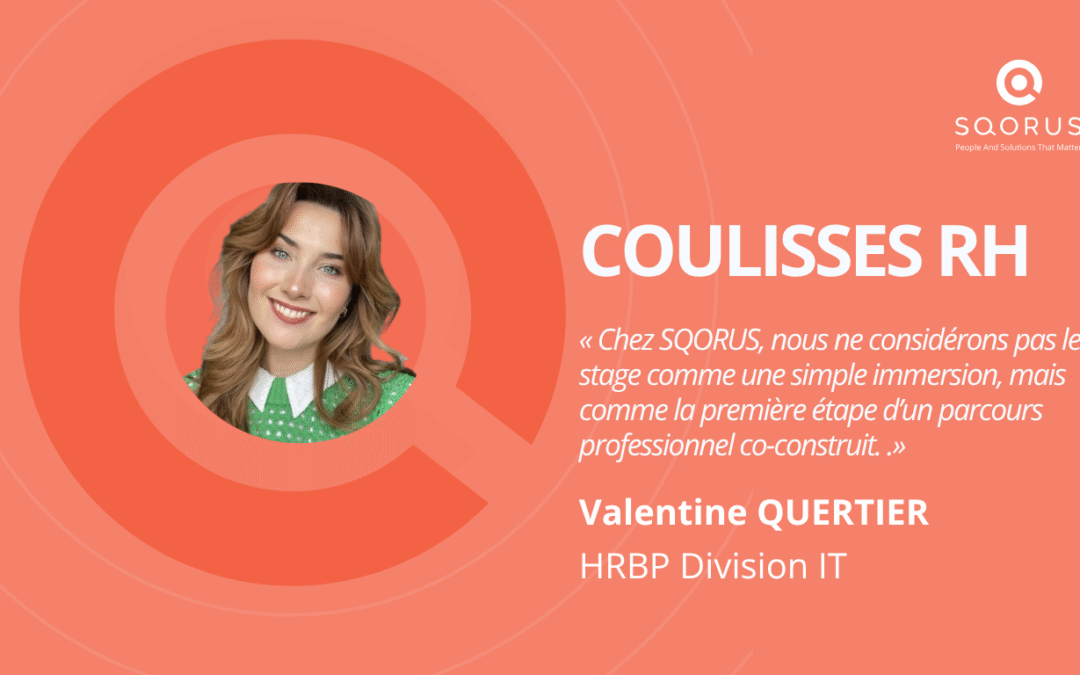
At SQORUS, we don’t see internships as mere immersion, but as the first step in a co-constructed career path. All our current internship offers internships are pre-employment, with a clear ambition: to enable each talent to plan for the long term by building with them a career path adapted to their aspirations.
En 2025, plus de 90 % de nos stagiaires spécialisés en transformation digitale ont poursuivi l’aventure avec nous.
This figure reflects a strong commitment: providing personalized, structured support focused on the future
Offer distribution and sourcing
Once the job offer has been drafted, it is posted on various channels and job boards such as LinkedIn, APEC or HelloWork, to make it visible to as many people as possible.
At the same time, the recruitment team actively seeks out profiles via tools such as LinkedIn Recruiter, using AI filters to target candidates, for example:
- who work in a specific sector (in the case of SQORUS, these are finance, EPM, IT and HRIS)
- who hold or have held positions similar to the one being recruited for
- that are located in the geographical area of our customer partners
- or who said they were open to work, i.e. open to new opportunities.
At this stage, the AI narrows the field of possibilities, but the result can still represent several hundred profiles. This is where the recruiter comes in. Not all the profiles filtered by the tool are contacted, nor are they automatically considered relevant for the position.
The recruiter analyzes the selection according to :
- job requirements
- customer context
- the level of experience expected
Receiving and sorting applications
When you apply for a job at SQORUS, your application arrives in our ATS, our application management tool. Its role is primarily organizational. It allows us to centralize all applications and track each file, avoiding oversights and duplications.
Some ATSs also offer automatic CV analysis using artificial intelligence, based on skills, experience and qualifications.
Unlike job board filters, which are based on standardized profiles, CV analysis in an ATS depends on the format and layout of the document sent. As a result, there are a number of elements that can prevent a CV from being read correctly, without having the slightest bearing on the quality of the profile. This is the case with highly graphic CVs or certain formats that are difficult for the tool to read (PNGs, complex layouts, etc.).
That’s why we don’t ask candidates to adapt their CVs for algorithms. Clarity, sincerity and readability are our best allies.
AI in your job application: good or bad idea?
Using AI to reformulate a CV or prepare for an interview is now commonplace.
Does it show? Sometimes, yes. Some content can seem very generic or lacking in personalization.
Is this a penalty? No, not in itself, because what counts at SQORUS is not the tool used but the authenticity of the content. An AI-generated CV or preparation can be an excellent starting point, as long as you add your examples and your real understanding of the position.
Should I mention it? No, it’s not necessary. What counts is the final result and what it says about you.
What the recruiter really wants to read
When we read a CV or LinkedIn profile, we try to understand in a few minutes who you are professionally and what you’re good at. Two candidates may have worked on the same projects and developed similar skills, yet give a totally different impression when reading their CVs.
Let’s take an example regularly encountered in the finance and ERP Council professions.
A candidate will write:
“Participation in an ERP Finance project
“Requirements gathering and testing
That’s true. But it’s not enough.
As a recruiter, faced with this type of line, several questions remain unanswered:
- What was your actual role in the project?
- Were you under observation or in charge?
- Does this experience match the need for which we are recruiting today?
In other words, even if your experience is relevant, it doesn’t become immediately readable.
Conversely, the SAME candidate may present this experience differently:
“Worked as a consultant on an ERP Finance (SAP S/4HANA) deployment project for a subsidiary of a banking group with around 150 users. Participated in gathering requirements from accounting teams, drafted functional specifications, contributed to user testing phases and supported teams during go-live.”
Here, the missions have not changed. The perception is different, however, because the recruiter no longer needs to interpret, and this interpretation can go either way. Either it enhances the profile, or it detracts from it.
Faced with a description that’s too vague, the recruiter fills in the blanks with his or her own references or hypotheses. He may then imagine a lower level of involvement (for example, a role of observer rather than actor) or a less demanding context. This is a natural mechanism. When a piece of information is not explicit, the brain simplifies and often, out of caution, tends to underestimate rather than overestimate.
The consequence is that a candidate may be perceived as less relevant than he or she really is, simply because the CV does not provide a clear measure of the scope of his or her experience.
If I had to give you just one piece of advice, it would be this: don’t just say what you’ve done, show what it means in reality.
Ask yourself this question as you review your experiences: would someone unfamiliar with this profession understand what I actually did and in what context? If the answer is no, it’s a good idea to rephrase.
Interviews: the human touch remains irreplaceable
Some companies are now testing automated interviews conducted by AI avatars. This is not the case at SQORUS. Our interviews are conducted by recruiters and business managers in a direct exchange format with no imposed script or automated evaluation.
The determining factors are not limited to technical skills. Motivation, attitude and project vision are essential soft skills in the Council business, especially as the consultant represents SQORUS directly to our customer partners. These qualities cannot be measured without dialogue.
In an interview, an AI can recognize words like “interest”, “motivation” or “career plan”, but it doesn’t pick up on the intention behind them. This would be the equivalent of judging a consultant solely on a PowerPoint presentation, without ever interacting with him or her. The content of his presentation may be good, but you won’t know how he interacts in a professional context, particularly with a customer, or how he handles an unexpected situation. Only a human interview can enlighten the recruiter on these points.
Follow-up and returns
Finally, AI can be used to automate certain communications, such as acknowledgements of receipt or status messages.
Without automation, simple information such as the receipt of a CV or the progress of a file can be delayed simply because one of the parties involved in the recruitment process (managers, directors, HR team, client, etc.) is unavailable at a given moment or lacks time.
The aim is to leave no-one without a response, and to ensure visibility at every stage of the process, out of respect for each candidate’s time and commitment.
And tomorrow? How these practices will evolve at SQORUS
In the short term, AI will continue to help us with administrative and organizational tasks.
In the medium term, it could improve note-taking during interviews.
In the long run, one thing remains certain: she won’t take the recruiter’s place.
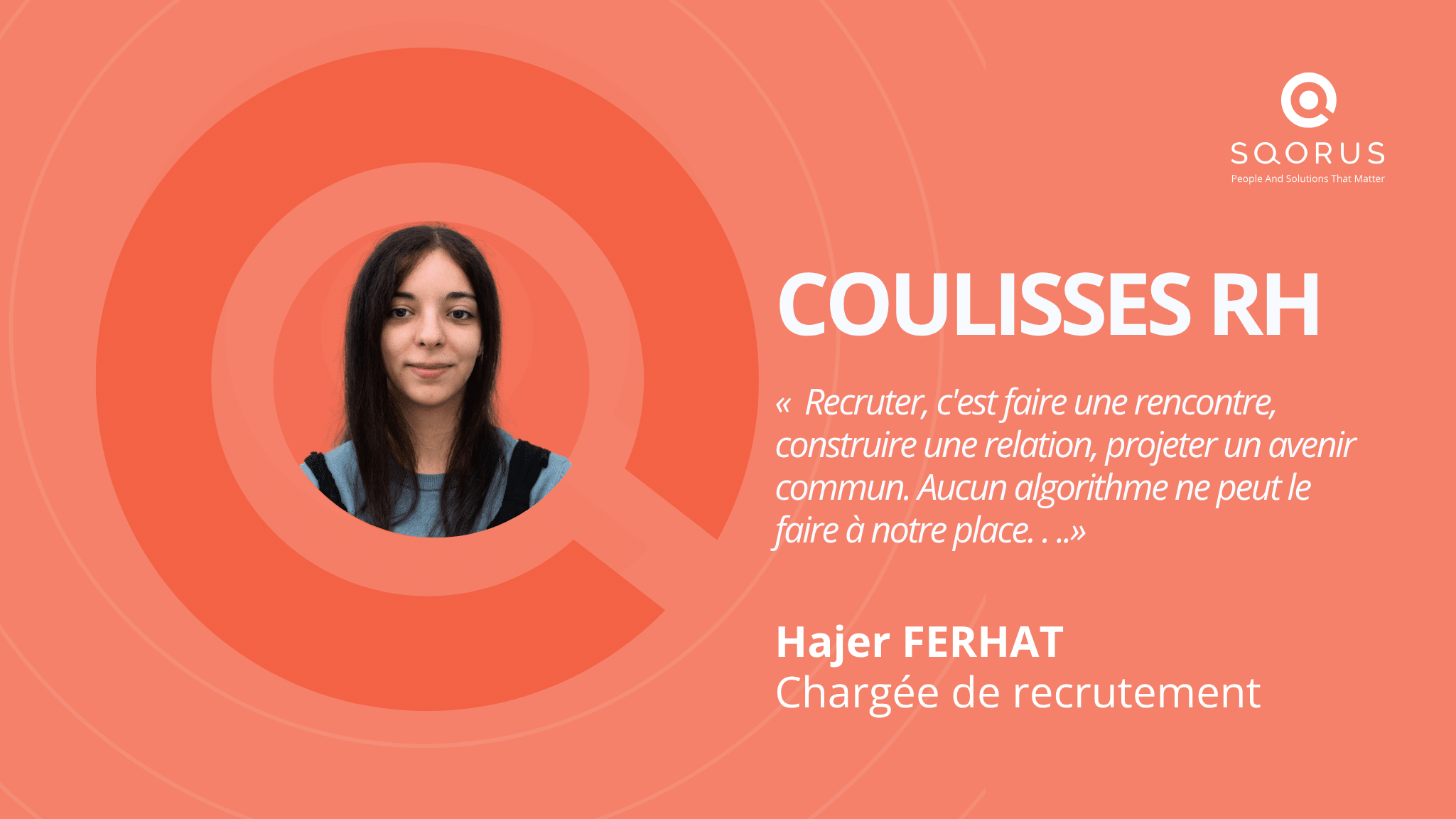
Because recruiting isn’t just about selecting a profile, it’s about meeting people, building a relationship and planning a common future. And no algorithm can do that for us.
Join a great place to work
Your career at SQORUS is more than just a job, it’s an opportunity to grow professionally and personally in an environment where individual development contributes to the growth of the whole.