

In brief
Duplicate identifiers, inconsistencies between subsidiaries, missing data: HR data entry errors cost time, money and compliance. Intelligent data entry interfaces enable you to detect these anomalies at source, before they contaminate your analyses and decisions. Find out how to deploy them effectively in your organization.
In an extended enterprise context, where subsidiaries interact with HR processes processes, maintaining quality data is a real challenge.
Errors in HR data can have far-reaching consequences: incorrect pay, inappropriate assignments, or failure to comply with regulatory obligations.
These problems are often linked to obsolete HRIS systems or manual data entry practices. The absence of inter-system consistency between HRIS tools increases the likelihood of duplicates or inconsistencies in the employee database. These challenges are directly linked to the broader issue of HR data quality, which we describe in detail in our dedicated article.
In this article, we explore how intelligent input interfaces can improve the quality of your HR data, prevent duplication and enhance the reliability of your information systems.
What is the impact of poor quality HR data?
Before discussing solutions, let’s consider the real consequences of poor HR data:
- Additional operational costs: HR teams waste considerable time on data correction and reconciliation tasks.
- Wrong decisions: Reports based on incomplete or duplicated data lead to biased analyses and inappropriate strategic decisions.
- Degraded employee experience: An employee whose login is duplicated may encounter problems accessing tools, payroll or career tracking, directly impacting his or her commitment.
- Compliance risks: Against a backdrop of tightening regulations(GDPR, Employee Transparency Directive), data reliability is becoming a legal imperative.
The problem of duplicate employee IDs between subsidiaries
Let’s take the case of a unique identifier assigned to the employees of a company or Group.
This identifier is intended to accompany the employee throughout his or her career, even when moving between Group entities.
In reality, however, HR staff in different subsidiaries may not be aware of a group-wide identifier that has already been assigned, in the absence of an upstream control mechanism.
Result?
The same individual can be assigned several identifiers. A costly source of error that complicates HR management, payroll…
Other frequent cases of duplication
- Internal mobility between subsidiaries without transfer of group ID
- Recruiting a former employee without detecting existing history
- M&A with data migration without prior deduplication
- Manual input with spelling variants (accents, hyphens, abbreviations)
- Data integration between HRIS, ATS and payroll tools without a common repository
The solution: improve data quality with intelligent input interfaces
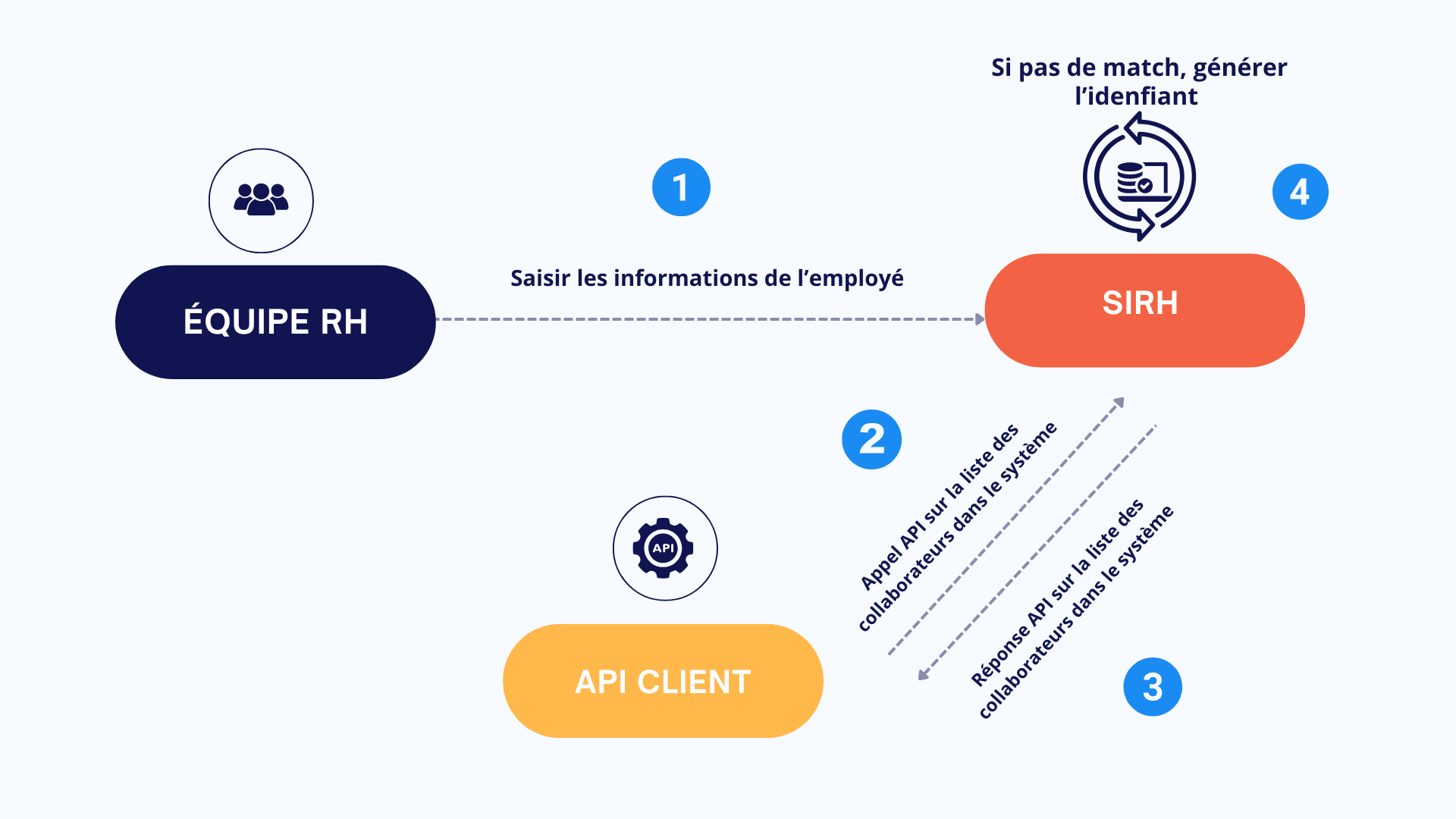
During the hiring process, HR enters the employee’s details (surname, first name, date of birth, etc.) into the system, and theintelligent interface, via API, queries the existing database to determine whether this is already known data or a new profile.
They analyze potential matches and present the results in the form of concrete use cases, enabling HR to make the right decision, independently.
There are three possible scenarios:
1. Unique match detected
If the data entered corresponds to an existing employee (name, date of birth, etc.), the tool flags the redundancy and suggests completing or modifying the profile instead of creating a duplicate.
This approach guarantees a centralized, up-to-date employee base and avoids the proliferation of multiple profiles for the same individual. This saves you downstream correction work.
2. Multiple possible matches
In ambiguous cases, where several profiles turn out to be similar, the tool alerts theHR user and displays the corresponding records for validation.
This adds a human verification step, while remaining AI-assisted, which limits errors and optimizes inter-system consistency. In this case, ambiguous cases (homonyms, partial records) can be detected.
So you retain control of the decision, while benefiting from intelligent assistance.
3. No relevant matches
When no existing profile matches the data provided, the system deduces that it is a new employee. It then allows HR to generate a new identifier, without the risk of conflict or duplication.
What are the benefits for HR on a day-to-day basis?
Implementing intelligent input interfaces offers tangible benefits for HR professionals:
- Significant time savings: HR teams are freed from tedious verification and correction tasks, freeing them to concentrate on higher value-added missions.
- Increased reporting reliability: clean data right from the source guarantees reliable analyses and dashboards for HR management. This is one of the pillars developed in our article on successful HR Data projects: 5 common mistakes to avoid. You gain visibility on your key HR indicators.
- Reduced maintenance costs: fewer post-corrections mean fewer resources mobilized for data cleansing.
- Simplified compliance: in the face of growing transparency requirements, reliable data facilitates regulatory reporting.
- Improved employee experience: a smooth administrative workflow contributes directly to employee engagement, a top priority for many HR departments today.
Beyond simple data entry: a lever for HR transformation
Intelligent interfaces are part of a broader vision of HR digitalization. They are often the first step in a global approach to improving data quality, which can then be extended to other processes:
- Digital onboarding: Smooth integration processes that capitalize on reliable data right from the hiring stage
- Simplified internal mobility: transfers between entities without loss of history or creation of duplicates
- Relevant HR analytics: Insights based on consolidated, reliable data
- Consistent employee experience: A frictionless administrative path through the company lifecycle
How to successfully deploy an intelligent
interface HR INTERFACE?
Essential steps for a successful deployment
Successful integration involves auditing existing systems, consolidating employee repositories, configuring APIs and validating business flows. It is also essential to include test phases, initial clean-up to avoid duplication, and ongoing quality control. A structured approach is the key to a stable, sustainable project.
Choosing the right HRIS solution for your needs
Each solution(Workday, SAP SuccessFactors, Oracle…) offers different levels of intelligence. The key is to select a tool that will automate processes, detect duplicates, and provide intuitive data entry adapted to your multi-entity structure. The choice of technology must be aligned with your overall HR strategy.
Training HR teams for successful adoption
Success depends on getting HR teams on board. We need to train them touse the intelligent assistant, make them aware of the challenges of HR data quality, and instill a culture of continuous improvement around intelligent data entry. People remain at the heart of HR digital transformation
Conclusion: a well-designed interface becomes a strategic tool
Intelligent input interfaces are more than just form screens. These are real operational safeguards, contributing to data quality and reliability.
By integrating assistance and detection logics, they enable companies to lay the foundations of a robust information system, based on clean data right from the start.
This approach is perfectly in line with a digital HR transformation approach, where every act of data entry becomes a lever for operational excellence.
Do you want to turn the quality of your HR data into a competitive advantage? Our HR integration experts will work with you step by step to set up intelligent interfaces tailored to your organization.
HR Data strategy: what if we accelerated?
Imagine a world where the HR function is propelled into a new dimension thanks to the power of data. What if this world were within our reach? Discover how to harness the full potential of HR Data to revolutionize your organization.
Contact
A project? A request?A question?
Contact us today and find out how we can work together to make your company’s digital future a reality.
FAQ – HR data quality and intelligent interfaces
Why is the quality of HR data so difficult to maintain in large groups?
In multi-entity companies, each subsidiary often manages its own data entry processes, using different tools and without a common repository. Internal mobility, mergers and acquisitions, and integration between systems (HRIS, payroll, ATS) multiply the number of data entry points, and therefore the risk of inconsistencies and duplication. Without a control mechanism at source, errors accumulate and become very costly to correct a posteriori.
What is an intelligent input interface and how does it work?
An intelligent input interface interrogates the existing database in real time when a new employee profile is created. It compares the data entered with existing profiles via matching algorithms (phonetic, textual similarity) and suggests appropriate actions to the HR user: complete an existing profile, validate an ambiguity or create a new profile. AI assists decision-making without replacing it, so that the user retains ultimate control.
Which HRIS natively support intelligent input interfaces?
The main platforms on the market (Workday, SAP SuccessFactors, Oracle HCM Cloud) offer native duplicate detection and data validation functionalities. Their level of sophistication varies according to version and configuration.
For organizations using older HRIS or bespoke solutions, connectors and API layers can be developed to integrate this intelligence without replacing the existing system.
How do you measure the impact of an intelligent input interface on data quality?
The key indicators to be monitored are: the rate of duplicates detected and avoided, the number of manual post-corrections, the average processing time for a hiring form, the error rate in regulatory exports (DADS, DSN) and the level of satisfaction of HR teams. A data quality dashboard set up as soon as the solution is deployed enables the ROI of the solution to be rapidly demonstrated.