In Brief
In October 2021, the city of The Dalles, Oregon, sued the state’s largest newspaper. It wanted to keep secret the amount of water consumed by Google’s data centers within its jurisdiction. Thirteen months later, it relented, and the figures were released. In 2021, the servers consumed 29% of the city’s water—a volume that had nearly tripled since 2017 (The Oregonian, via DatacenterDynamics and AP, 2022).
This second installment of our “Digital & Impact” series continues our exploration of the digital lifecycle, from mining to waste.
The cloud is nothing like a cloud. To cool its servers and generate electricity, it draws on water resources that are becoming increasingly scarce, and AI is accelerating this trend. The question is no longer just how much water the digital sector consumes, but where, when, and at whose expense. Here’s an overview.
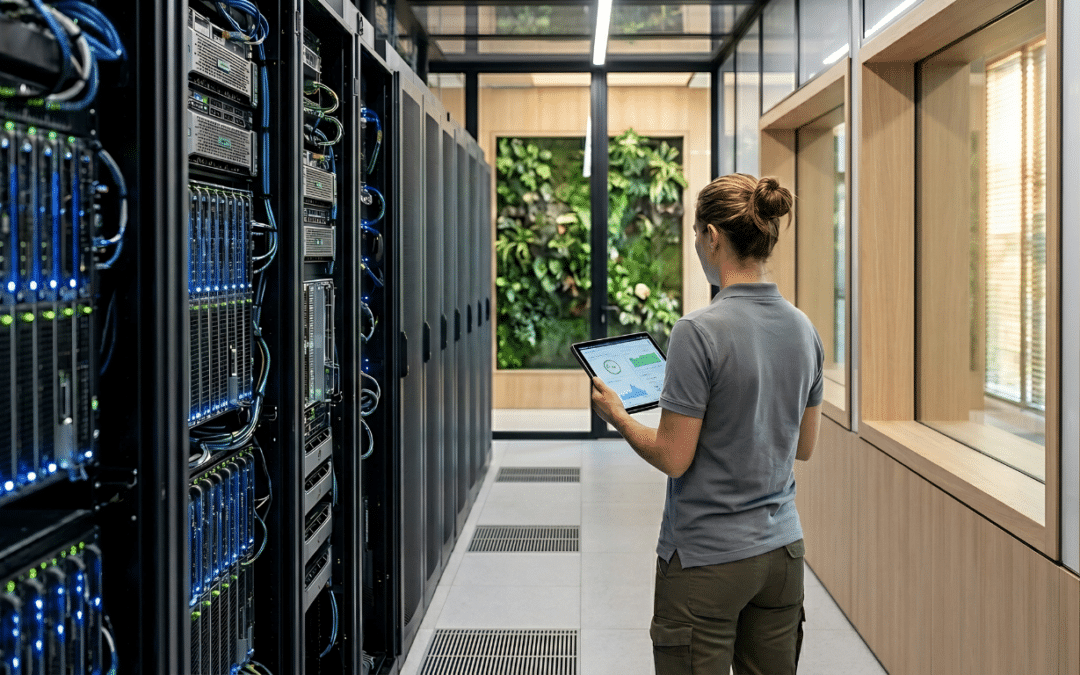
Why does a data center use water?
To remove heat from servers, many data centers use cooling towers where water evaporates, a technique that saves electricity. According to Google, in many locations, water cooling can reduce a data center’s energy consumption by about 10% compared to air cooling (Google, 2026). This benefit comes at the cost of freshwater, which is often potable. In these towers, about 80% of the water drawn evaporates and therefore does not return to its source (Li et al., 2025).
The water hidden behind the electrical outlet
Most of the water used in the digital sector is invisible, because power plants—particularly thermal power plants—also consume water for cooling. In the United States, data centers directly consumed 66 billion liters of water in 2023—enough to fill more than 26,000 Olympic-sized swimming pools—up from 21 billion in 2014. Their indirect water footprint, linked to electricity generation, is nearly 800 billion liters—about twelve times as much (LBNL, 2024).
Globally, the International Energy Agency attributes approximately two-thirds of the water consumed by data centers to power generation, one-quarter to on-site cooling, and the remainder to the manufacture of semiconductors and chips (IEA, 2025).
How much water does an AI query require?
Published estimates range from a few drops to more than half a liter. Google reports 0.26 milliliters—about five drops—for a median query on Gemini, counting only the cooling of its data centers (Google, 2025). Sam Altman, co-founder of OpenAI, estimates in a blog post that each ChatGPT request uses about 0.3 milliliters, without specifying the method (Altman, 2025). The life cycle assessment of Mistral AI, conducted in collaboration with Carbone 4 and with support from ADEME, also takes into account server manufacturing and yields a result of 45 milliliters for a 400-token response, which is roughly equivalent to one page of text (Mistral AI and The Register, 2025).
In 2024, researchers at the University of California, Riverside finally estimated that a 100-word email written using GPT-4 consumed 519 milliliters of water, a volume that varies significantly depending on the location of the data center (Washington Post, 2024).
None of these figures are wrong, but they don’t measure the same thing. A figure without a defined scope means nothing.
AI Is Driving Up Water Consumption in Data Centers
According to LBNL projections, an AI server with eight graphics processing units will exceed an average power consumption of 5 kW in 2026. A conventional server with two processors, on the other hand, will remain below 0.8 kW. (LBNL, 2024). Almost all of this electricity is converted into heat that must be dissipated, and water consumption skyrockets. Google consumed 10.9 billion gallons of water in 2025—approximately 41 billion liters, or 16,500 Olympic-sized swimming pools. This is 34% more than in 2024 and more than double the 2021 level, with its data centers accounting for most of the increase (Google and Axios, 2026). According to the International Energy Agency, water consumption by data centers worldwide could rise from approximately 560 billion liters in 2023 to 1,200 billion in 2030—equivalent to 224,000 to 480,000 Olympic-sized swimming pools (IEA, 2025). The methods differ significantly. For 2023, the IEA even estimates global consumption to be lower than the carbon footprint attributed by LBNL to electricity used by U.S. data centers alone.
The United Nations University, for its part, estimates the water footprint of electricity used by all data centers at 9,300 billion liters in 2030, the equivalent of the basic domestic water needs of the 1.3 billion people living in sub-Saharan Africa (UNU-INWEH, 2026).
Title

Where there is already a shortage of water
According to a landmark study published in 2016, approximately 4 billion people—or two-thirds of the world’s population—experience severe water shortages for at least one month each year (Mekonnen and Hoekstra, 2016). However, in the United States, about two-thirds of the data centers built or planned since 2022 are located in areas of high water stress (Bloomberg, 2025). Globally, SourceMaterial and The Guardian have identified 38 active data centers operated by Amazon, Microsoft, and Google in water-stressed regions, with another 24 under development (SourceMaterial, 2025).
Secrecy as a Rule
This data remains difficult to obtain. Amazon did not release its first global figure until June 2026, reporting that its data centers consumed 2.5 billion gallons in 2025—equivalent to approximately 9.5 billion liters or nearly 3,800 Olympic-sized swimming pools (Amazon and Trellis, 2026). In October 2025, an internal memo from 2022 revealed by SourceMaterial showed that company executives viewed transparency as a “one-way street.” Amazon describes this document as obsolete (SourceMaterial, 2025).
Drought vs. Servers
In 2023, Uruguay experienced its worst drought in 74 years, according to authorities. With its main reservoir nearly dry, the public water utility drew water from the brackish estuary of the Río de la Plata, and the tap water took on a salty taste. Graffiti on the walls of Montevideo read “No es sequía, es saqueo” (It’s not a drought, it’s plundering), a slogan targeting water allocated to industry, from soybeans to paper pulp (The Guardian and El Salto, 2023). At the same time, Google was planning a data center whose initial design called for 7.6 million liters of water per day—equivalent to about three Olympic-sized swimming pools or the daily household water consumption of 55,000 people (The Guardian and Thomson Reuters Foundation, 2023). Google has since scaled back its project and opted for air cooling (El Observador, 2023).
In Chile, an environmental court partially revoked the permit for a Google data center in Santiago in February 2024, requiring that its water impact assessment take climate change into account. In September 2024, Google announced it would start from scratch with an air-cooled project (Reuters, 2024). In Spain, Meta’s project in Talavera de la Reina, located in the Tagus River basin—an area prone to recurring droughts—faced opposition from the collective Tu Nube Seca Mi Río, “Your Cloud Is Drying Up My River” (El Salto and Next, 2024).
Fleas vs. Rice Fields
Digital technology is thirsty even before it reaches data centers. In 2021, in the midst of a drought—the worst in more than half a century, according to authorities—Taiwan cut off irrigation to approximately 74,000 hectares, one-fifth of its irrigated land, to preserve water for households and factories. Among them were TSMC’s facilities, which at the time accounted for more than 90% of global production capacity for the most advanced chips and had to bring in water by truck (The New York Times, 2021).
Climate Change: A Risk Multiplier
Heat waves are increasing cooling demands at the very same time that water is becoming scarcer. On July 19, 2022—the day the United Kingdom set an all-time record of 40.3 °C—Google and Oracle data centers in London had to shut down servers. At Oracle, two cooling units failed after being pushed beyond their design limits. One of the UK’s largest hospital groups, Guy’s and St. Thomas’, even had to cancel or postpone surgeries after its two data centers failed due to the heat (Tech Monitor and PublicTechnology, 2022).
In December 2024, Amazon requested a 48% increase in water consumption at its three data centers in Aragon, citing climate change and the expected rise in heat waves. Three months later, the Aragonese government requested to be included in a European Union-funded drought relief program (SourceMaterial and Aragón Hoy, 2025).
The warmer the climate gets, the more water data centers consume—and often in places where water is already scarce.
The Responses of the Tech Giants—and Their Limitations
Cooling Without Evaporation
Since August 2024, all new data centers designed by Microsoft have relied on closed-loop liquid cooling at the chip level. Each site would thus save more than 125 million liters of water per year—enough to fill more than 50 Olympic-sized swimming pools. Microsoft announced pilot projects in 2026 in Phoenix and Wisconsin, with operations set to begin in late 2027 (Microsoft, 2024). Google, for its part, has committed to using water cooling only if the local water source is deemed safe, and to using air or recycled water in areas where water sources are at risk (Google, 2026).
But the water saved often comes at the cost of increased electricity consumption. Microsoft acknowledges a slight increase in its energy consumption compared to its evaporative designs (Microsoft, 2024). And low-carbon electricity isn’t necessarily water-efficient. Replacing coal with bioenergy can reduce the carbon footprint of electricity by an average of 72 percent, but increase its water footprint by more than thirty times (UNU-INWEH, 2026). Optimizing a single indicator often amounts to shifting the problem elsewhere.
The “water-positive” pledge in question
Microsoft, Google, and AWS—Amazon’s cloud division—have pledged to return more water than they consume by 2030, in particular by funding water restoration projects. This is what is known as being “water positive.” (Microsoft, 2020; AWS, 2022; Google, 2026). Google says it has thus restored 7.7 billion gallons by 2025 (Google, 2026). But water cannot be offset like carbon, warns Aaron Wemhoff, an energy efficiency specialist at Villanova University. “Carbon is a global problem; water is more local. ” Improving access to water in one region does nothing to help a distant community that has been deprived of it. A former water sustainability manager at Amazon himself called this logic “unethical.” (SourceMaterial, 2025).
How much water do data centers in France consume?
Volumes remain modest, but the sites are growing in scale. The 23 leading colocation data center operators, which operate nearly 160 sites, withdrew 575,000 m³ of water in 2024—the equivalent of 230 Olympic-sized swimming pools. This is 15% less than in 2023, but it consists almost exclusively of drinking water. While this volume is modest compared to industrial and agricultural uses, it can nonetheless create conflicts over water use in the areas where these centers are located, notes Arcep. The centers opened in 2024 have an average capacity of 20 MW, more than double that of those opened in 2023. Data from cloud service providers, collected in 2026, will be published in the spring of 2027. (Arcep, 2026).
Regulatory measures are already in place. Under the 2021 REEN Act, the tax benefit for data centers on electricity is contingent, in particular, on a quantitative indicator limiting cooling water usage, the value of which must be set by decree (CIBS, Art. L. 312-70). In the European Union, data center operators with an installed computing capacity of at least 500 kW must report their total water intake—including potable water—annually to a European database (Delegated Regulation (EU) 2024/1364).
Key Figures
| Indicator | Value | Olympic-size swimming pools | Source |
|---|---|---|---|
| Water Consumed by Data Centers Worldwide (2023) | ≈ 560 billion liters | ≈ 224,000 | IEA, 2025 |
| Water Consumed by Data Centers Worldwide: Projection for 2030 | ≈ 1,200 billion liters | ≈ 480,000 | IEA, 2025 |
| Water consumed on-site (for cooling) by U.S. data centers (2023) | 66 billion liters | ≈ 26,400 | LBNL, 2024 |
| Water Consumed to Generate Electricity for U.S. Data Centers (2023) | ≈ 800 billionliters—12 times on-site consumption | ≈ 320,000 | LBNL, 2024 |
| Water Consumed by Google, All Sites Combined (2025) | ≈ 41 billionliters, 10.9 billion gallons, up 34% from 2024 | ≈ 16,500 | Google, 2026; Axios, 2026 |
| Water per generative AI request, depending on the scope of the calculation | from 0.26 to 45mL—cooling only (Google) to full life cycle (Mistral AI) | – | Google, 2025; Mistral AI, 2025 |
| Water consumption by the 23 leading colocation data center operators in France (2024) | 575,000m³, or 575 million liters | ≈ 230 | Arcep, 2026 |
Equivalents calculated using the standard Olympic pool size of 2,500 m³ (50 m × 25 m × 2 m), then rounded. The global and U.S. figures are based on different methods and are not directly comparable.
What Companies Can Do Right Now
- Request data from your cloud providers and hosting providers. Water consumption per site, percentage of potable water, and—most importantly—the scope of the data: cooling only or including electricity.
- Examine where your data is processed. The same computation does not have the same impact depending on the climate, the electricity mix, and the water stress in the region where it is hosted.
- Don’t judge based solely on carbon. A low-carbon solution can be water-intensive, and vice versa.
- Choose the right model for the right use. The impact of an AI model generally increases with its size (Mistral AI, 2025).
- Incorporate water considerations into responsible IT procurement and non-financial reporting.
SQORUS supports you in your responsible digital approach
Water reminds us of something obvious: The cloud is a physical infrastructure, rooted in regions where it shares resources with residents, farmers, and manufacturers. Measuring usage, asking questions of your providers, and adjusting your habits—that’s already taking action.
With more than 35 years of experience in the digital transformation of HR, Finance, and IT functions, we support organizations in their journey toward responsible digital transformation.
Holders of the Responsible Digital Level 1 Certification awarded by the Institute for Responsible Digital Technology, and the 2026 EcoVadis Gold Medal with a score of 85/100 (97th percentile); we view these accolades as a testament to our commitment to a more environmentally friendly digital future.
Do you have a project? A request? Any questions?
FAQ
How much water does a query to a generative AI consume?
It depends on the scope chosen. Google reports 0.26 mL for a median Gemini query, counting only cooling costs, while Mistral AI reports 45 mL for a 400-token response—roughly one page—which includes, among other things, server manufacturing costs. Comparing these figures without considering their methodologies makes no sense.
Why worry if volumes remain low nationwide?
Because water is a local resource. A data center draws water from a specific aquifer or river—often a source of drinking water—and some of it evaporates. During periods of drought, it competes directly with residents and agriculture in the same watershed.
Is waterless cooling the solution?
This is part of the solution. Closed-loop systems and air cooling significantly reduce water withdrawal but consume more electricity. The right choice depends on the climate, the electricity mix, and local water stress.