

The success of an HRIS deployment often boils down to the ability to implement an end-to-end solution, meeting the target HR purpose of course, but also making it profitable by integrating it into a more global application scheme.
But is that enough? How about swapping the HRIS “Information System” for the HRIS “Solution”?
Integrating the HR processes defined by the business into the chosen HRIS is a good thing! But considering them from the outset of deployment in your application architecture is better in terms of saving time and optimizing costs.
Beyond technical implementation, a successful HRIS rollout is also based on a global vision: that of a system that serves HR strategy and the employee experience. The shift from “HRIS tool” to “HRIS solution” reflects this change in approach. It’s no longer a question of simply implementing a technology, but of designing a coherent, integrated and scalable system that serves processes, teams and HR data.
Today’s HRIS deployment challenges: more than just implementation
Excessive focus on HRIS modules to the detriment of overall vision
It’s a fact that integration often focuses on the deployment of the chosen HRIS modules. As a result, the methodology requires HR to focus primarily on its definition and screens.
Workshops then define the processes and content (actors, workflow, fields, values) required to put the process itself into practice. Detailed questions emerge concerning data sources (input and output), cybersecurity, all the players involved, link(s) to other applications (directory, payroll system, ticketing tools, etc.).
The back-and-forth with the other players in the ecosystem begins, and solutions are then studied or re-examined to cover the entire process.
This very frequent pattern often leads to late revisions of interfaces, unanticipated adjustments and delays in the project chain. Team energy is then absorbed by managing these impacts, to the detriment of overall design and change management.
The risks of HRIS planning that neglects the overall process
Planning may take into account the needs of the overall architecture, but the visible part of the iceberg is prioritized over the overall process.
The most obvious example is the test phase. The focus is on the visible part of the process, to help end-users adopt the tool. As a result, the end-to-end process and its actors are sacrificed, with planning phases reduced or out of phase with schedules due to back-and-forth with third parties.
Anomalies are then dealt with too late, usually after the go live, which puts the players concerned at risk and undermines adoption of the tool.
This is all the more true as HRIS deployment projects are now taking place in hybrid, multi-tool and multi-country environments. The absence of an overall vision translates into a loss of coherence, degraded data quality and, ultimately, a reduced use value for the HR function.
Why global architecture is key to successful HRIS deployment
Thinking about the “Solution” at the start of the project allows us to define and integrate all needs, identify the expectations of employees and managers, with the aim of aligning people, unified processes and IT tools.
This ensures that the operational part of the process is not forgotten, and that all players are involved in the project. All too often, end-users are caught off guard and not sufficiently involved in the tool.
This anticipation also helps to secure technological choices, optimize data flows and reduce friction between different application bricks. It facilitates change management, by giving meaning to each stage of the project, and by involving the business departments, IT, Payroll, IT Security and Data from the outset.
Finally, “solution thinking” encourages cross-functional governance: rather than managing isolated modules, we steer a complete value chain, from recruitment to talent management, via payroll, performance and training.
Best practices for a solution-oriented HRIS deployment
To best address these issues, here are a few non-exhaustive Councils to guarantee your path to success:
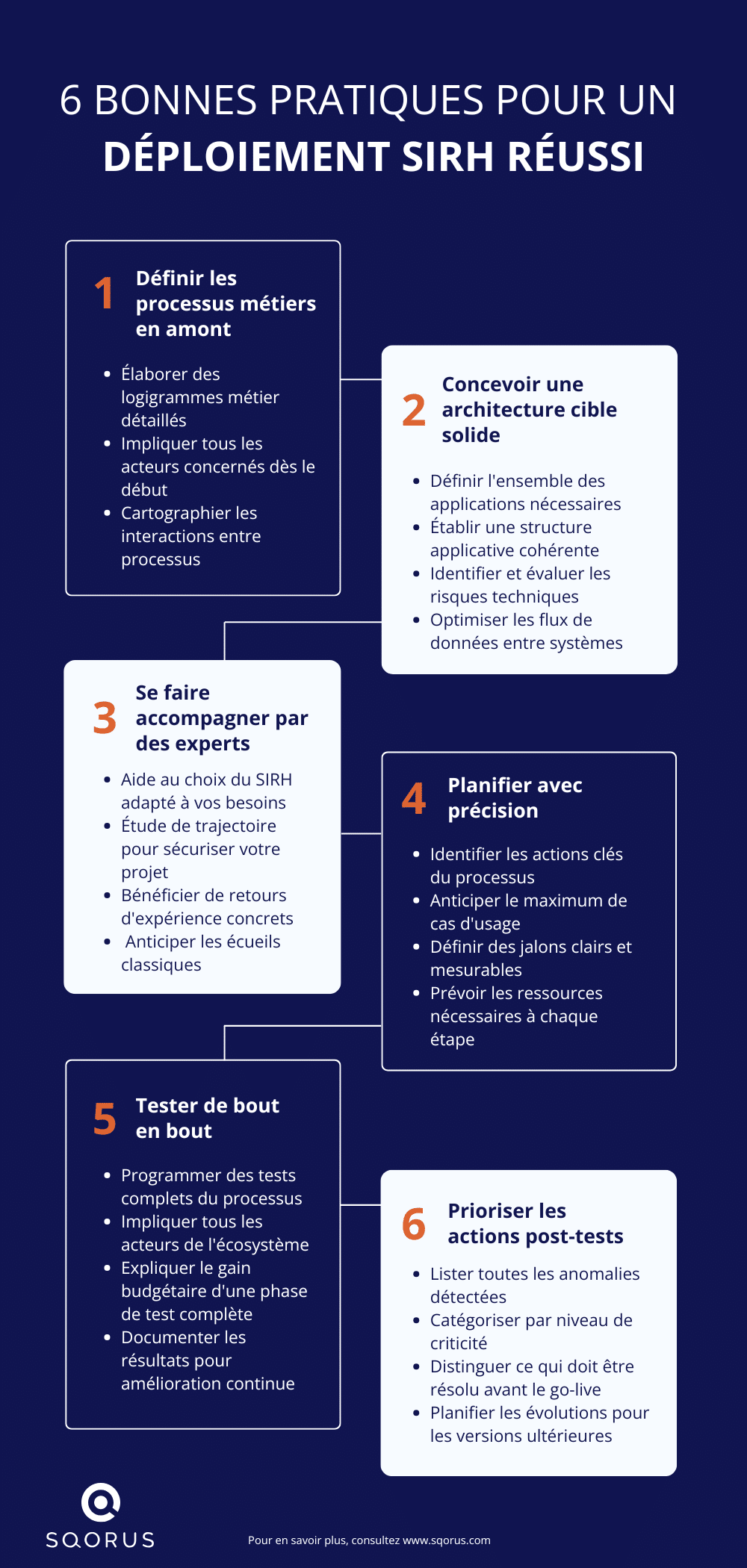
- Define and study target business processes upstream (set up business logigrams with the target players concerned)
- Agree on a target architecture and plan the entire project accordingly. This involves defining all applications, establishing the application structure, verifying risks, network and security constraints, checking data flows to optimize them, and identifying all the players in the ecosystem.
- Assistance in choosing an HRIS (or at least a trajectory study)
- Plan by identifying the key actions for putting the process into practice, identifying the maximum number of cases to be covered
- Defend and program an end-to-end test period approach, explaining the budgetary gains to be made by integrating it.
- At the end of the tests, list and prioritize the anomalies/improvements to be implemented before and after the go live.
In addition to these best practices, it is essential to embed the project in a continuous lifecycle logic. Deployment is not the end, but the beginning of sustainable management: data quality monitoring, adoption measurement, continuous process improvement and solution evolution monitoring.
Conclusion: from HRIS to HRIS, the future of digital HR transformation projects
Evolving HR needs and available technologies are prompting us to fundamentally rethink our approach to HRIS deployment. The transition from a simple “information system” to a true“HR solution” represents much more than a semantic change, it’s an essential paradigm shift.
The organizations that succeed in their digital HR transformation are those that adopt this holistic vision, where HRIS deployment is not an end in itself, but a lever for creating value for the whole company.
Ultimately, new-generation HR information systems must be conceived as living, integrated ecosystems, capable of supporting the company in its current and future challenges: talent attraction and retention, employee engagement, organizational agility and data-driven management.
Designing an HRIS means thinking of the HR ecosystem as a coherent, agile and scalable whole, capable of meeting the challenges of today and tomorrow.
SQORUS supports its customers in implementing HRIS, an approach that places the solution at the heart of HR performance. If you are interested in this subject, please contact us to discuss your HRIS deployment project and find out how our solution approach can meet your specific challenges.
34 HR innovations and trends for 2025
Discover the latest HR innovations and trends and accelerate your digital transformation.
Contact
A project? A request?A question?
Contact us today and find out how we can work together to make your company’s digital future a reality.