


In many companies, Purchasing-Finance processes remain compartmentalized, leading to breaks in the flow of data, longer processing times and a lack of visibility on spending.
The absence of a unified system, or an obsoleteFinance IS, complicates operational management. This dysfunction has a direct impact on the value chain: poor purchasing repository, manual management of supplier orders, validation errors and lack of strategic steering affect overall performance. An entire internal ecosystem is slowed down, hampering the agility expected in an uncertain economic climate.
Already familiar with the concept of Source-to-Pay? This article will take you straight to the heart of the matter: concrete problems, optimization levers and conditions for a successful S2P transformation. If you’d like to lay the foundations first, take a look at our article: “What is Source-to-Pay?“
Whether you’re just thinking about it, or have already embarked on a project to transform your purchasing-finance processes, this article will provide you with the essential keys to a successful transition to optimized Source-to-Pay.
The hidden costs of poorly integrated Source-to-Pay
A non-integrated Source to Pay process generates many invisible costs: data entry errors, duplicate invoices, payment delays, penalties for regulatory non-compliance, and even lost earnings on supplier discounts. On top of this, resources are mobilized unnecessarily for low-value-added tasks, such as manual invoice processing or monitoring the validation cycle.
The lack of task automation also results in a lack of visibility on expenditure and a decline in budgetary control. These inefficiencies, which are often underestimated, undermine competitiveness and hamper rapid decision-making.
Warning signs
- A high level of maverick spending, difficult to track and control
- Time-consuming manual reconciliations between Purchasing and Finance teams
- Limited visibility of supplier commitments in real time
- Longer payment terms, exposing the organization to LME penalties
- An inability to produce reliable indicators of consolidated expenditure
If several of these signals are present, this is a clear indicator that the S2P process needs to be overhauled.
S2P to prepare your company for electronic invoicing and compliance
Regulations require companies to adopt compliant, audited systems capable of managing e-invoicing.
The deadline has now been set: from September 1, 2026, all VAT-registered companies must be able to receive electronic invoices. The obligation to issue invoices will apply to large companies and ETIs from the same date, and to SMEs and micro-enterprises from September 1, 2027.
In a context of harmonized regulatory frameworks (such as IFRS or mandatory B2B invoicing), S2P plays a central role in ensuring regulatory compliance.
Integrating these requirements into the heart of an ERP accounting solution avoids the risk of penalties, reduces data entry errors and speeds uppayment security. It’s best to anticipate these changes to turn regulatory constraints into competitive advantages.
To find out more about this subject: Electronic invoicing and e-reporting: what you need to know
Improve the reliability of purchasing data for better performance management
Today’s CFOs have access to a growing volume of data, but they still need to be reliable.Financial performance managementrelies on dashboards fed by an up-to-date purchasing repository, a unified supplier base, and fluid data between ERP modules.
An effective S2P strategy provides reliable performance indicators to guide decisions, secure investments and sustainably improve performance. Data becomes a governance tool, accessible and valuable at all times.
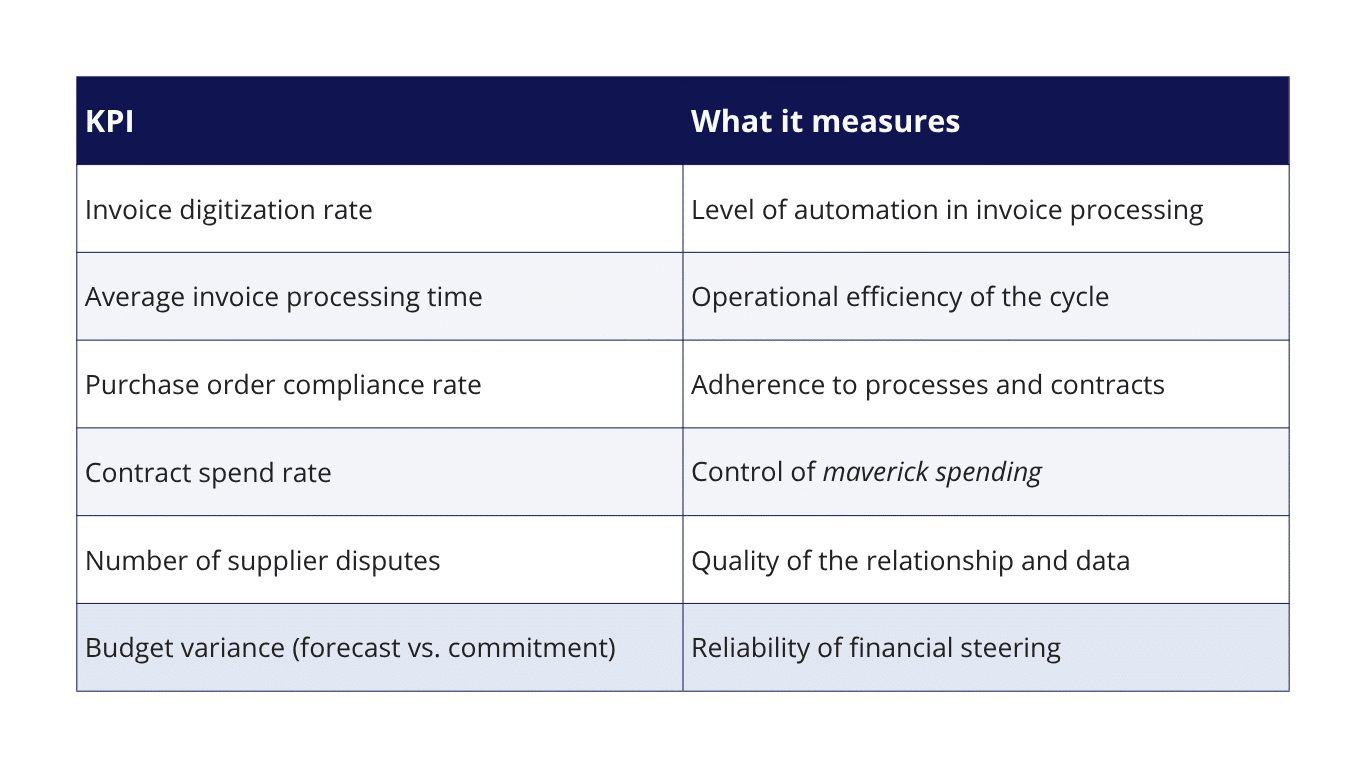
S2P KPIs to monitor as a priority
By monitoring them regularly, you ensure that your S2P solution delivers tangible, measurable results, with a view to continuous improvement.
What are the key stages in implementing a Source-to-Pay strategy?
Best practices for successful S2P deployment
Setting up an S2P platform requires a structured approach involving both the project owner (MOA) and the project manager (MOE). This is where the mapping of needs, the choice of solutions and the structuring of technical and business roles come into play. Success relies as much on technology as on change management.
The way in which a digital transformation projectis structured is crucial to the success of Source-to-Pay and its long-term viability. Involving the right players from the outset is essential to guarantee the adoption and increased efficiency of processes.
The key stages in a successful S2P project
- Mapping of existing processes: identifying existing processes, tools and interfaces between Purchasing, Finance and Business teams.
- Defining functional requirements: formalizing business needs and technical constraints in precise specifications
- Solution selection: evaluate the S2P platforms on the market according to your context, maturity and objectives (scalability, interoperability, compliance).
- Gradual deployment: a phased approach to limit risks and ensure service continuity
- Supporting change: training teams, communicating benefits and anchoring new practices over time
Concrete results expected from optimized Source-to-Pay
A well-deployed solution reduces direct and indirect costs, boosts productivity and improves the reliability of contractual processes.
Processing times are reduced, automated controls ensure an auditable trail, and business players benefit from complete transparency on the key stages of the process. All within an omnichannel system, open and interconnected with the supplier ecosystem. In this way, each player gains in efficiency while contributing to the overall modernization objectives.
The central role of the CFO in S2P change management
As a business partner, the CFO has a strategic cross-functional vision that enables him/her to steer the S2P transformation as effectively as possible. By coordinating purchasing, IT and finance functions, they can take a holistic approach to issues, anticipate regulatory constraints, integrate appropriate ERP modules and orchestrate the various business players.
With anintegrated purchasing-finance solution, the CFO becomes the central driver of corporate modernization. It transforms the Finance function into an initiative center that drives long-term performance.
Would you like to digitize your S2P process?
Our experts are at your disposal to discuss your challenges and present our approach.

Indicators and strategic benefits of Source-to-Pay
KPIs to track to measure the effectiveness of your S2P
Source to PayKPIs to monitor include: invoice digitization rate, average processing time, purchase order compliance rate, number of supplier disputes, budget variance between forecast and commitment.
These indicators can be used to identify friction points, optimize circuits and measure progress in real time as part of a financial audit.
By monitoring them regularly, the company ensures that its S2P solution delivers tangible, measurable results, with a view to continuous improvement.
Source-to-Pay for a stronger role as business partner
By providing visibility, control and strategic management of expenses, Source to Pay naturally reinforces the role of Finance as a business partner.
Finance ceases to be perceived as a mere cost center, and becomes a performance lever aligned with operational priorities. It valorizes purchasing data as a high value-added resource and contributes to the continuous optimization of the company’s overall operations. In this way, S2P becomes a transformation gas pedal, at the service of improved collective performance.
More agile, data-driven finance
Thanks to intelligent systems supervision, companies can transform their IS and ERP systems into levers for growth. Source-to-Pay, conceived as a fluid, automated global process aligned with business challenges, enables the Finance function to evolve towards greater agility, predictivity and performance. It’s an opportunity for Finance Departments to become proactive, steering the company via a consolidated, strategic vision.
Conclusion: S2P, a strategic lever for operational and financial excellence
Source-to-Pay is more than just a technological evolution: it’s a profound transformation that redefines the way companies manage their purchasing and finances.
As we’ve seen throughout this article, a well-integrated S2P not only reduces direct and indirect costs, but also increases visibility of spending, improves regulatory compliance and reinforces the strategic role of the Finance function.
Implementing an effective S2P solution requires a structured approach, involving close collaboration between purchasing, finance and IT teams, as well as appropriate change management support.
SQORUS supports companies in their Source-to-Pay projects, from the definition of requirements through to operational implementation. Our S2P project management experts will help you structure your project, select the solutions best suited to your needs, and ensure seamless integration with your existing systems.
Contact us to find out how we can help you make your Source-to-Pay a real performance driver for your company.
How do you choose the ideal Finance IS?
Discover how Finance IS is transforming finance departments, and optimize your processes to make the Finance function a true strategic partner.
Contact
A project? A request?A question?
Contact us today and find out how we can work together to make your company’s digital future a reality.
FAQ – Source-to-Pay
What's the difference between Source-to-Pay and Procure-to-Pay?
The difference between Source-to-Pay and Procure-to-Pay is that Source-to-Pay covers the entire purchasing process, including the upstream sourcing phase, unlike Procure-to-Pay, which focuses only on operations after supplier selection. S2P therefore offers a more strategic and comprehensive approach.
What are the benefits of an S2P system for SMEs?
A well-integrated S2P saves SMEs time, reduces manual errors and gives them greater control over their spending. It also fosters better compliance, particularly in the face of mandatory e-invoicing from September 2026, and healthier supplier relations.
How do you successfully integrate an S2P solution?
Successful integration relies on a sound definition of requirements, solid project governance(MOA/MOE) and change management support. Involving end-users is also crucial to ensure adoption.
How do I know if my S2P process is mature?
There are a number of signs that transformation is needed: a high rate of out-of-contract spending, frequent manual reconciliations, insufficient visibility of supplier commitments, and difficulties in anticipating the e-invoicing obligation.
An S2P compliance audit provides an objective diagnosis and identifies priority areas.