

In brief
Adopting innovative managerial practices in isolation is not enough, and can even lead to frustration. To be successful, managerial innovation must be part of a global and coherent approach.
Discover the 4 key steps to building a management model adapted to your organization, from defining guidelines to transforming corporate culture.
Managerial innovation does not simply satisfy a desire for novelty, it represents a profound adaptation to the new challenges of a changing world. Every organization needs to take ownership of this key issue, if it is to remain competitive and attractive.
In recent years, ideas for innovative new management practices have emerged, and it has been tempting for many organizations to adopt some of them. Unfortunately, this can be a source of disappointment and frustration when these practices are isolated and do not form part of a coherent overall approach.
Today, organizations are looking to build a specific strategy to guide their managerial innovation process and integrate new management practices fully adapted to their current challenges. To help you understand the main trends underlying this approach, our article onmanagerial innovation and its models lays down some useful foundations before going into detail about the stages involved.
With this in mind, here’s a look at the 4 main stages in a managerial innovation approach.
Stage 1 of managerial innovation: building guidelines
Today’s world is undergoing profound change. The consequences of these changes will place new demands on the way companies operate. For this first step, it is useful to look back at the general issues facing companies, and to establish a synthetic vision of them.

Faced with major changes in their environment, companies need to evolve the way they operate so that they can develop responsiveness, commitment,continuous innovation,collective intelligence and meaning.
While these general objectives are common to all companies, it is then important torefine our thinking and take into account the company’s specific strategic axes by asking the following questions:
- Which of these challenges are particularly important for my company?
- What individual and collective operating methods will be particularly relevant to support our strategic objectives?
Examples:
- If strategic objectives are particularly focused on improving customer relations, a particular focus can be placed on employee commitment;
- If we want to developcontinuous innovation, we’ll give priority to developing creativity in everyone;
- If the emphasis is on diversification or decentralization,autonomy and subsidiarity can bedeveloped in particular;
- Or seek to develop project mode, if you want to strengthen synergies between departments.
Once the general challenges have been identified, and refined by taking into account the strategic axes, we then have the guidelines that will ensure coherence and relevance for an in-depth transformation of our internal operations.
Now it’s time for the transformation.
How to implement the transformation of collective operating modes. Where to start?
Stage 2 of managerial innovation: developing a company-specific managerial model
To transform a company’s internal system, the main levers are of 3 interdependent orders: culture, organization and management system.
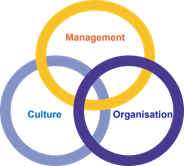
The management system is the first and most important axis of transformation. Management, the cornerstone of the pyramid system, is not only the symbol of transformation, but also the key to effective transformation.
For successful business transformation,managerial innovation is at the heart of the company’s transformation and adaptation to its environment. It plays a key role in establishing a high-performance culture, organization and management system.
Managerial transformation must be adapted to each company’s DNA, culture and objectives. Indeed, each organization has its own specific managerial innovation model, which needs to be carefully worked out. For this reason, and to give meaning and mobilize managers, many organizations opt to draw up a Managerial Charter.
A synthetic, visual and accessible reference tool, the managerial charter will be the frame of reference for all managers committed to transforming their posture.
On this subject, we have written an article explaining why and how to create an effective management charter. Find out how you can help your company evolve and adapt to a constantly changing environment.
Stage 3 of managerial innovation: transforming managerial attitudes and practices
Once the Charter has been finalized and communicated, the concrete transformation of managerial attitudes and practices can begin.
It has three main focuses:
- The development of managerial skills, with the creation of a managerial skills repository that will serve as a basis for positioning managers and as a starting point for making them active participants in their own training programs.
- The promotion of new practices with the creation of a toolbox for managers, made up of concrete practices and rituals to adopt.
- The development of managerial communities that mobilize and instill a new collective dynamic, based on sharing, exchange and co-development.
This is often the stage whenchange management support is most decisive: without a structured mechanism to anchor new practices, managers quickly fall back into their habits.
Stage 4 of managerial innovation: changing the organization and culture
While the transformation of the management system can rapidly make new operating modes effective, it is important tosupport this transformation at a more general level, and in particular :
- Check that the company’s culture (in particular, the behaviors valued within the company) is in phase with these transformations. And if it isn’t, it can be changed by working on values.
- Through ongoing dialogue with managers, we also check that structural factors are not hindering theevolution of certain attitudes and practices.
In addition, beyond the obstacles to be overcome, developing a more collaborative managerial culture comes with certain conditions, and can benefit from the implementation of complementary actions at organizational level:
- Development ofemployee autonomy and accountability(with support depending on profile)
- Strengthening direct management-employee dialogue and bottom-up communication
- Development of innovation and intrapreneurship: provide a framework that facilitates the development of ideas and links them to strategic priorities.
- Work on cohesion and a sense of belonging, to counterbalance the decline in coordination and formal communication.
Key indicators for steering your managerial innovation approach
- Managers’ level of commitment (dedicated barometer)
- Rate of adoption of new managerial practices and rituals
- Evolution of employee engagement score (pulse surveys)
- Quality of feedback between managers and teams
- Number of bottom-up initiatives generated and processed
- Turnover and absenteeism rates
These indicators enable us to continuously adjust the system and demonstrate the value of the approach to management. They are part of a logic ofcontinuous improvement of the employee experience, at the heart of any employee-centric strategy.
Conclusion: a concrete approach to managerial innovation
Developing innovation within the company is crucial to maintaining sustainable growth. Whilemanagerial innovation can be seen in new practices, it cannot be summed up in this aspect alone. Above all, it involves a new understanding of the function, and therefore a new posture to adopt. That’s whysupport for managers is often crucial.
It takes shape in a global strategy adapted to the new challenges of the economic and social environment, but also respecting the company’s DNA and strategy.
Adopting a managerial innovation approach also means keeping a close eye on societal developments, changes in people’s relationship with work, and the ways in which we think we can move forward, build and create value collectively.
These four stages do not constitute a fixed model: they form an iterative framework, to be revisited regularly as the organization evolves. Organizations that succeed in their managerial transformation are those that accept that the process will never end, and that commit to it with method, patience and a shared conviction at all levels of the hierarchy. External support can make all the difference in avoiding the classic mistakes that cause change projects to fail.
Would you like to initiate or accelerate your managerial innovation process? Our SQORUS consultants can help you address the human aspects of your transformations: change management, new ways of working and managing. Contact us to discuss your needs!
34 HR innovations and trends for 2025
Discover the latest HR innovations and trends and accelerate your digital transformation.
Contact
A project? A request?A question?
Contact us today and find out how we can work together to make your company’s digital future a reality.
FAQ – Managerial innovation approach
Where do you start with a managerial innovation approach?
The first step is always diagnosis: identifying the organization's strategic priorities, assessing current managerial practices and pinpointing areas of friction. This analysis enables us to define coherent guidelines before embarking on any transformation. Without this initial framing, the innovative practices adopted run the risk of remaining isolated and generating frustration rather than commitment.
What is a management charter and why create one?
The managerial charter is a synthetic reference framework that formalizes the postures, behaviors and practices expected of managers within the organization. It gives meaning to the transformation, creates a common language and is the starting point for manager training and development programs. It is all the more effective when it is co-constructed with the managers themselves.
How do you measure the success of a managerial innovation approach?
Key indicators include the level of commitment of managers and employees (internal barometers), the rate of adoption of new practices, changes in turnover and absenteeism, and the quality of feedback within teams. Regular pulse surveys enable us to monitor developments in real time and adjust the system on an ongoing basis.
See also our feature on "HR strategy management tools".
- What are the key issues facing HR departments today?
- Organization, talent management, recruitment: priority HR projects?
- Human resources management: what HR strategies for the future?
- Best practices to manage your HR strategy in an optimal way
- The different HR management tools to carry out your HR strategy
- HRIS software: the different areas of intervention for the HR function
- How to convince your management to invest in an HRIS tool?
- Is it necessary to be accompanied in the management of an HR strategy?
- What indicators should be defined to measure the performance of an HR strategy?
- HR strategy: how to achieve effective HR reporting?
- Who should drive HR projects in the company?
- Setting up a working group for an HR project: who should be involved?