

Digital transformation is a prerequisite for many organizations. In a context where companies are constantly evolving, and where technological innovations are forcing them to rethink their practices, finding the right strategy can sometimes prove difficult. Where does digitalization start? What trajectory should we adopt? Is your company ready for this change? Are your HRIS and digital tools up to date or do they need to be upgraded? This article is designed to help you draw up a master plan and answer these questions.
What is an HRIS master plan?
An HRIS master plan is a strategic tool for defining and planning the implementation of an HRIS tailored to your company’s specific needs.
Its implementation combines the strategic orientations of your general management with the various HR professions and the IT Department. It therefore enables us to project what your HRIS should look like tomorrow (3 to 5 years ahead), as well as the resources needed to get you there (in terms of resources, budgets, processes, projects, etc.).
There’s no one-size-fits-all model, as its development depends on the context of your company or organization.
Why create an HRIS master plan?
The master plan is an essential tool to enable HR to meet the company’s strategic ambitions. The purpose of the HRIS master plan is :
- bring together the various stakeholders (senior management, HR team and IT department) to define priority needs;
- Identify HR strengths and weaknesses in line with the company’s development plans;
- identify and prioritize actions to improve your HR processes
- anticipate the impact of changes to your HRIS ;
- identify upstream returns on investment, and therefore decide whether or not to launch each action.
This work will enable you to specify and formalize an HR policy and practices adapted to your company and your development projects.
How do you draw up an HRIS master plan for your company?
Here’s how, in 6 steps, we explain how to set up an HRIS master plan for your company:
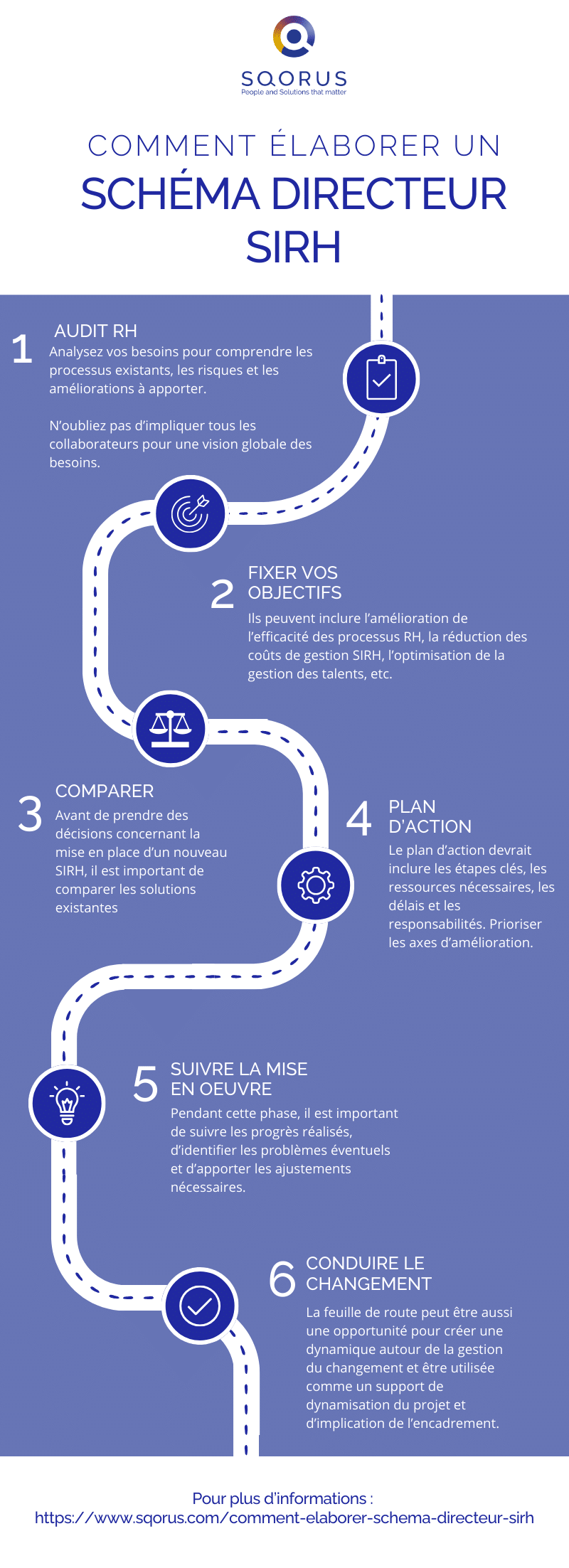
#1 Conduct an internal HR audit and needs analysis
To draw up an HRIS master plan, we need to understand existing processes, potential risks and areas for improvement. You need to involve all HR stakeholders, as well as the IT department, COMEX members, managers and employees, to get a global view of needs.
#2 Specify your objectives
These objectives can include improving the efficiency of HR processes, reducing HRIS management costs, optimizing talent management, and so on.
#3 Compare existing HRIS systems
Before making any decisions concerning the implementation of a new HRIS, it is important to compare existing solutions on the market according to the target functional scope. This helps you determine whether an integrated solution would better meet your company’s needs, or whether a best-of-breed solution would be more appropriate.
#4 Define an action plan
Once you’ve identified needs, defined objectives and compared existing solutions, you can draw up an action plan for implementing the HRIS master plan. This action plan should include milestones, resources, deadlines and responsibilities. Prioritize areas for improvement.
#5 Implement and monitor the plan
Once the action plan is in place, you can start implementing the HRIS. During this phase, it’s important to monitor progress, identify any problems and make any necessary adjustments.
#6 Leading change
The roadmap can also be an opportunity to create a dynamic around change management, and can be used to energize the project and involve management.
Conclusion for an HRIS master plan
In short, the HRIS master plan is a strategic tool that enables companies to effectively manage their HR by aligning their HR objectives with their overall strategy.
Let’s not forget that it’s first necessary to understand whether your organization is mature enough to undertake these transformations, and to identify the skills already present in your teams to support these changes in tools, practices and culture.
SQORUS is here to help you with this. Do not hesitate to contact us to discuss this with our experts.
Read more
Sources
- https://ingenierie-creations.fr/le-schema-directeur-informatique/
- https://www.viragegroup.com/ressources/schema-directeur-mise-en-oeuvre-projet/
- https://www.convictionsrh.com/fr/offers/sirh-digital/schema-directeur-et-strategie-digitale-sirh/
- https://auvergnerhonealpes.aract.fr/sites/default/files/upload/ressources/guidebao-grh-schemadirecteurrh.pdf
- https://www.convictionsrh.com/fr/offers/sirh-digital/schema-directeur-et-strategie-digitale-sirh/
- https://auvergnerhonealpes.aract.fr/sites/default/files/upload/ressources/guidebao-grh-schemadirecteurrh.pdf
What tools can you use to manage your HR strategy?
Optimize your HR strategy and discover the essential management tools you need to achieve your objectives. Don't miss this opportunity to successfully manage your HR projects.
See also our feature on "HR strategy management tools".
- What are the key issues facing HR departments today?
- Organization, talent management, recruitment: priority HR projects?
- Human resources management: what HR strategies for the future?
- Best practices to manage your HR strategy in an optimal way
- The different HR management tools to carry out your HR strategy
- HRIS software: the different areas of intervention for the HR function
- How to convince your management to invest in an HRIS tool?
- Is it necessary to be accompanied in the management of an HR strategy?
- What indicators should be defined to measure the performance of an HR strategy?
- HR strategy: how to achieve effective HR reporting?
- Who should drive HR projects in the company?
- Setting up a working group for an HR project: who should be involved?
Contact
A project? A request?A question?
Contact us today and find out how we can work together to make your company’s digital future a reality.