

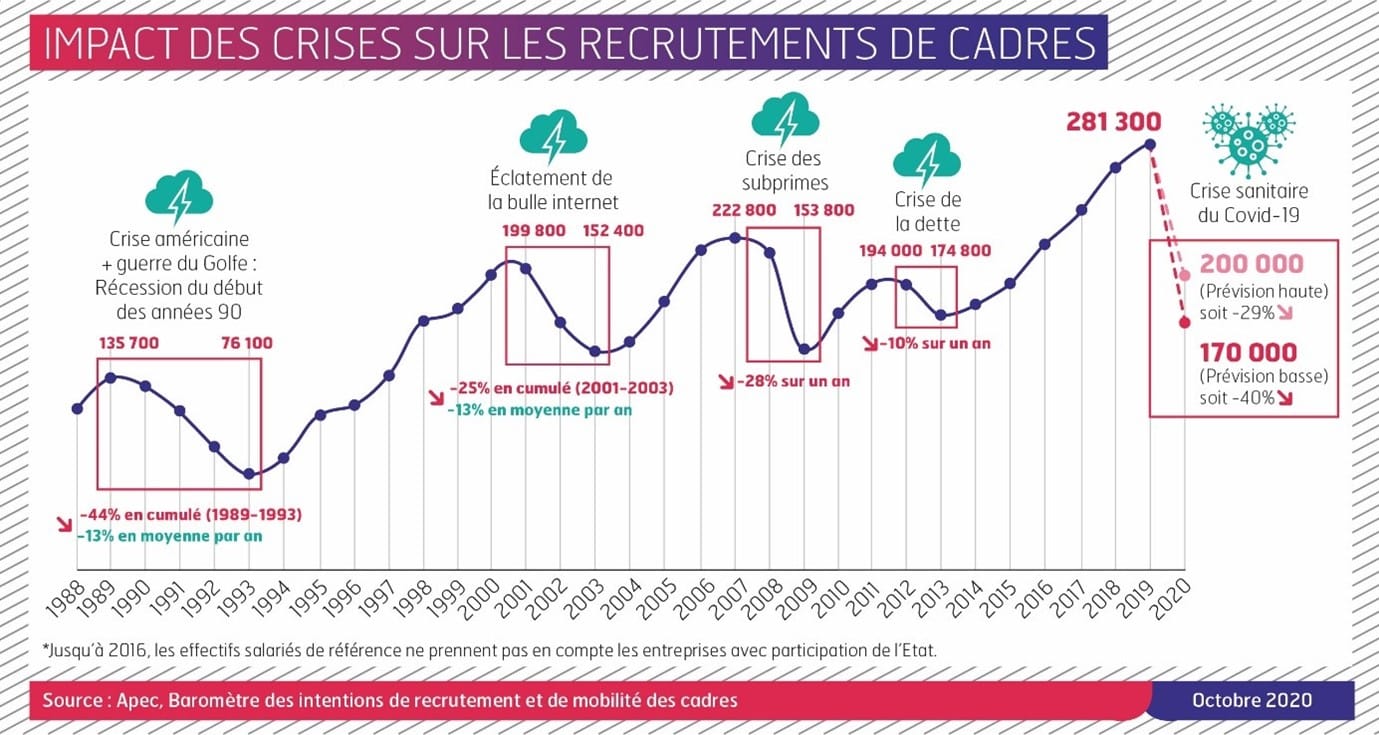
The pre-crisis and post-crisis worlds are not the same. We saw this during the financial crisis of 2008, or during the health crisis of 2020. The impacts on the job market are inevitable, as shown in the chart below from APEC.
Around ten years ago, with the acceleration of Web 2.0, we saw changes in recruitment practices (publication of job offers, job boards, etc.) with new approaches in the hands of recruiters, thanks to HR solutions called ATS(Application Tracking System).
Until then, recruiters faced several difficulties: managing a huge mass of CVs, reducing the recruitment time… These difficulties have not totally disappeared, but the tools have still had a positive impact for recruiters.
But beyond APEC’s assessment of recruitment difficulties for the year 2022, we are witnessing an unprecedented change in the labor market in the wake of the health crisis: employees already in post have more opportunities, and the number of resignations is on the rise (“Great resignation”).
This particular situation is only the result of the upheavals in the labor market over the last two years, marked by “Stop & Go”, hiring freezes, layoffs… These consequences are interesting to analyze from different angles. In particular, the fact that candidates have changed, and recruiters naturally need to adapt accordingly.
I was invited to a HR morning dedicated to recruiters at the end of 2022 on the theme “Candidates are changing and you?” hosted by MyRHLine. This one mentioned several changes: for some job offers where the recruiter received more than 20 CVs on average, he will now have to be satisfied with half of them. Candidates discuss or negotiate their working conditions and remuneration right from the first interview, and are more interested in the values of the company they are applying to, to make sure they are aligned with it…
Unquestionably, the balance of power has been rebalanced between candidate and recruiter, and this will become, in my opinion, “the norm in the future of recruitment”! There will be no turning back, and companies that maintain their positions will draw the consequences.
You need to consider the candidate/prospect as a “potential employee” in a “Customer” approach from the very first contact, and not wait for them to become an employee of the company.
But let’s get back to the main topic of this article. How should the Recruiter adapt in a constantly changing world?
How can human resources adapt to change?
To respond to this in a methodical way, even if there is no turnkey solution, we need to imagine recruitment differently, by putting ourselves in the shoes of a candidate.
For Alain Fournier, Director of Recruitment and Diversity at Groupe BPCE, the paradigm has changed: ” It used to be that recruiters could just post ads and wait for applications to come in, but those days are gone. We can no longer be static with the candidates. From now on, they are the ones who expect companies to come and meet them and promote their project. They only apply if they are convinced that the company will meet their expectations “. It is therefore clear that upstream of theemployee experience, HR teams must invest in thecandidate experience.
Candidates are researching your company, be prepared! It’s up to you to attract them with a “Market” approach: ” 95% of candidates find out about a company before applying ” (Stepstone).
In an increasingly digitalized world, enhancing your employer brand (re)becomes the real key issue when recruiting and even more so in a context of war for talent. The recruiter has to innovate and change his strategy/posture, and several techniques exist to help him in this sense…
What strategy should you adopt to keep up with all these changes in recruitment?
Inbound recruitment
In reality, the recruiter is already practicing marketing when he or she publishes an ad on a job board or when he or she shares information on the career site. But it needs to go one step further, by applying well-known and recognized marketing techniques such as inbound marketing:inbound recruitment consists of attracting potential candidates to feed the recruitment pool, or targeted profiles corresponding to a need, by implementing appropriate strategies: ” 93% of companies that have adopted inbound marketing have seen a real positive impact on their conversion rate ” (HubSpot).
This step having been conclusive, you were able to either attract his intention, his curiosity or confirm his interest to join your company. The candidate applies and enters a new ” candidate experience “.
At this stage, it should be simple from the start, with clear steps and an intuitive user interface. A lengthy application process can quickly discourage the candidate from going through with the application.
Meet the candidate for an interview with a “human” approach
I surveyed a sample of recruiters via LinkedIn at the end of 2022, and observed that the recruiter should devote around 80% of theinterview timeto the candidate. In my interactions with recruiters, one shared a successful new approach: ” At the beginning of the interview, I put the candidate’s resume aside and asked him to introduce himself. This created an atmosphere of exchange and trust “.
As Alexandre Pachulski, co-founder of Talensoft (acquired by Cegid), points out: “ More than ever, recruitment requires us to focus on people rather than CVs “.
If you’re interested in the subject, we’ve written an article about it: Human Centric.
Profiling in interviews
There are several methods and techniques that recruiters use to conduct interviews: technical knowledge tests, real-life situations, assessment centers, etc. Without making comparisons between them, I was nonetheless struck by an assessment technique used live during the HR morning session mentioned above, namely that of profiling: ” We all do behavioral profiling on a daily basis with those around us. What if we could do the same thing in interviews by paying more attention to the non-verbal communication of the candidates? “Arnaud Bochurberg, teacher in psychosociology of communication.
Indeed, the decision to hire is made after theinterview. However, recruiters are not trained to analyze a candidate’s personality. DISC (Dominant, Influential, Stable and Conforming) and MBTI (Myers Briggs Type Indicator) are two assessment tools that provide indicators of a candidate’s personality and behavior.
Their use would allow us to match the candidate’s profile with that of the recruiting team. As WeSuggest explains: “It’s good that candidates can express themselves freely about their qualities during the interview… but if they can learn more about themselves, it’s even better!
Finally, instead of asking the candidate questions like: “How do you see yourself in the next 2 to 5 years?”, it would be more appropriate to present a business project that the candidate can relate to over the long term, and then explain his or her role in the organization.
Offer innovative onboarding that is true to the employer brand
Recruitment doesn’t end with the signature, it’s time foronboarding with an “innovative” approach that is true to the employer brand!
For HR teams, the day the employee arrives may seem like an ordinary day to welcome (again) a new employee to the company. But for the candidate, this is a special day! He has spoken so enthusiastically about it to his friends and family, like a new adventure that is beginning… So how can we make sure that theonboarding is successful?
Following on from thecandidate and employeeexperience,employee induction must reflect your employer brand, through which you have attracted prospects and succeeded in converting them. This is the logical next step in the recruitment process. Employers must be faithful to their identity and to theexternal image they have sold upstream, at the risk of seeing their employer brand damaged and their onboarding fail, and thus their recruitment.
” 50% of employees say they are ready to quit within the first month of employment ” (A survey conducted for Robert Half). Poor reception was cited as a reason for dissatisfaction by 29.9%.
Onboarding is the final touch to confirm your recruitment, and playing the innovation card can help you stand out from the crowd at this decisive stage.
Several companies have understood this, such as marketing agency Element three, which has chosen to develop a unique “Welcome pack”. It includes: a personalized welcome note from their CEO, a vintage keychain featuring the key to the building, and a list of fun challenges that the new hire must complete over the next 4 weeks.
Conclusion on the recruitment of tomorrow
In conclusion, the recruiter and the HR function in general must continue to innovate, to (re)think about new approachesas it demonstrated during the crisis, in order to adapt with agility to an ever-changing world.
The year 2023 is off to a strong start with that technological revolution everyone is talking about, ChatGPT, and that’s just the beginning… So how will recruiters approach it? What are the risks and opportunities that this new technology can bring to recruiters? So many questions that we can raise and that recruiters are already starting to talk about on social networks ….
SQORUS, a Council specialized in the digital transformation of HR, Finance and IT functions, can help you with your recruitment, HR innovation, data and AI issues. Do not hesitate to contact us to discuss this with our experts.
What tools can you use to manage your HR strategy?
Optimize your HR strategy and discover the essential management tools you need to achieve your objectives. Don't miss this opportunity to successfully manage your HR projects.
See also our feature on "HR strategy management tools".
- What are the key issues facing HR departments today?
- Organization, talent management, recruitment: priority HR projects?
- Human resources management: what HR strategies for the future?
- Best practices to manage your HR strategy in an optimal way
- The different HR management tools to carry out your HR strategy
- HRIS software: the different areas of intervention for the HR function
- How to convince your management to invest in an HRIS tool?
- Is it necessary to be accompanied in the management of an HR strategy?
- What indicators should be defined to measure the performance of an HR strategy?
- HR strategy: how to achieve effective HR reporting?
- Who should drive HR projects in the company?
- Setting up a working group for an HR project: who should be involved?
Contact
A project? A request?A question?
Contact us today and find out how we can work together to make your company’s digital future a reality.